
AI Foundations in Organisations: Why Artificial Intelligence Success Begins Long Before Implementation
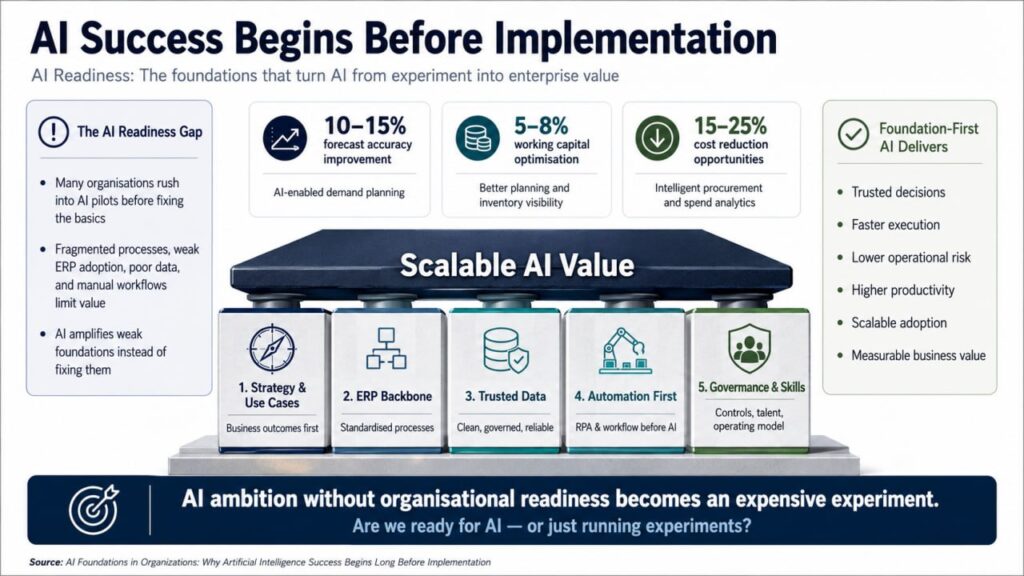
Executive Summary Artificial intelligence has become one of the most transformative—and misunderstood—strategic priorities in global organisations. Every boardroom, every C-suite, and nearly every business function is now asking urgent questions: How can we leverage AI? Where should we automate? How will AI enhance productivity? What cost reductions are achievable? How can we improve customer experience? Where might AI inform better decisions? These are undoubtedly the right questions to be asking. However, the organisations that will succeed with AI are not those that rush most quickly into pilots, copilots, chatbots, predictive analytics, or agentic AI initiatives. Rather, they are the organisations that first answer a far more fundamental question: Is our organisation truly ready for artificial intelligence? The uncomfortable truth is this: AI does not succeed in isolation. Its success depends critically upon the maturity of an organisation’s strategy, business processes, integrated systems, data architecture, automation capabilities, governance frameworks, risk management disciplines, and people capabilities. Without these essential foundations in place, AI quickly becomes another well-intentioned technology experiment that generates initial excitement, attracts headlines, and captures budget—but delivers limited tangible, measurable business value. This article examines the five critical foundations that every organisation must establish before embarking on a serious journey to scale artificial intelligence. These foundations are not optional nice-to-haves. They are mandatory prerequisites that determine whether AI becomes a genuine transformation lever or merely an expensive technology distraction. The AI Readiness Challenge: Why Foundations Matter The business world is currently experiencing what might be called “AI fever.” Executives read about breakthrough applications of generative AI, large language models, machine learning, and autonomous agents. They see competitors announcing AI initiatives. They face investor pressure to demonstrate innovation and AI readiness. They experience internal pressure from technology teams eager to experiment with new tools and capabilities. The result, predictably, is a wave of organisations launching AI pilots without adequate preparation. Chatbots that provide frustratingly unhelpful responses. Predictive models trained on insufficient or poor-quality data generate unreliable forecasts. AI-powered recommendations that users quickly learn to ignore. Analytics dashboards that decision-makers distrust. Automation initiatives that discover legacy processes are so broken that no amount of AI can fix them. The common theme in these failures is not that the AI technology itself is inadequate. Modern AI platforms—whether cloud-based machine learning services, large language models, or specialised domain models—are remarkably sophisticated. The failures occur because organisations attempted to apply advanced AI techniques without first establishing the foundational capabilities upon which AI depends. Consider a familiar analogy: attempting to build a skyscraper on unstable soil. The architectural design might be magnificent. The construction materials might be world-class. The engineering might be flawless. But without solid bedrock and proper foundations, the structure will inevitably fail. Similarly, artificial intelligence is only as durable, valuable, and reliable as the organisational foundation upon which it rests. Foundation One: Clear AI Strategy and Compelling Business-Driven Use Cases The first and most critical foundation is clarity of purpose and strategic alignment. AI should not be implemented because it is fashionable, because competitors are exploring it, or because the technology is available. Rather, AI should be deployed purposefully to solve genuine business problems, eliminate critical inefficiencies, or create measurable, quantifiable business value. This distinction—between technology-driven and business-driven AI initiatives—determines whether AI becomes transformational or merely experimental. The Strategic Compass: Critical Questions A well-articulated AI strategy provides the compass guiding investment decisions and resource allocation. This strategy should answer the following essential questions: • Productivity Enhancement: Which business areas would benefit most from improved productivity or accelerated processing?• Effort Reduction: Where can AI meaningfully reduce manual effort, human intervention, and repetitive work?• Decision Effectiveness: How might AI enhance the quality, speed, and consistency of decision-making processes?• Risk Mitigation: Where can AI reduce operational risk, financial risk, compliance risk, or cybersecurity exposure?• Customer Experience: Can AI improve customer service, personalisation, responsiveness, or satisfaction?• Employee Experience: Where might AI improve employee satisfaction, reduce administrative burden, or accelerate career development?• Competitive Advantage: Where might AI create genuine, defensible, durable competitive advantage? The most successful AI initiatives across industries share a common characteristic: they are business-led rather than technology-led. The best organisations identify the business outcome first, deeply understand the current pain or opportunity, and then ask whether and how AI can play a meaningful role in addressing it. High-Impact AI Use Case Categories Experience across organisations has identified several categories of high-impact AI applications that consistently deliver business value when properly implemented: Supply Chain and Demand Planning: Improving demand forecasting accuracy using AI-powered models that incorporate market signals, seasonality, promotional calendars, and historical patterns. Enhanced forecast accuracy reduces inventory carrying costs, minimises stockouts, and optimises procurement timing. Organisations report improvements in forecast accuracy of 10-15% and working capital optimisation of 5-8%. Procure-to-Pay Automation: Automating three-way invoice matching, reducing manual reconciliation effort, detecting duplicate invoices, and identifying discrepancies. This extends beyond simple RPA to include intelligent matching of invoices to purchase orders and receipts, reducing dispute resolution time and accelerating payment cycles. Customer Service Intelligence: Routing customer inquiries to the optimal support agent based on complexity, required expertise, language requirements, and agent availability. AI can also provide agents with real-time suggested responses, relevant knowledge articles, and escalation recommendations, improving first-contact resolution rates and customer satisfaction. Fraud Detection and Anomaly Identification: Identifying unusual transaction patterns, potential fraud, and compliance exceptions using unsupervised learning models that adapt continuously to emerging fraud tactics. This application protects revenue, reduces losses, and strengthens control environments across finance, payments, and claims processing. Intelligent Procurement and Sourcing Support: Analysing spend patterns, identifying maverick spend, recommending supplier consolidation opportunities, and benchmarking prices against market data. AI augments procurement decisions with data-driven insights that often identify 15-25% cost reduction opportunities. Automated Project Status and Risk Reporting: Extracting project status information, identifying risks, and generating status reports without manual compilation. This reduces administrative burden on project teams and ensures consistent, objective status communication to leadership. Contract Analysis and Compliance: Processing and analysing large document collections—contracts, service level agreements, regulatory documents—to identify obligations, extract key terms, flag
From AI Pilots to AI Value: Why CIOs Must Move Beyond Experimentation
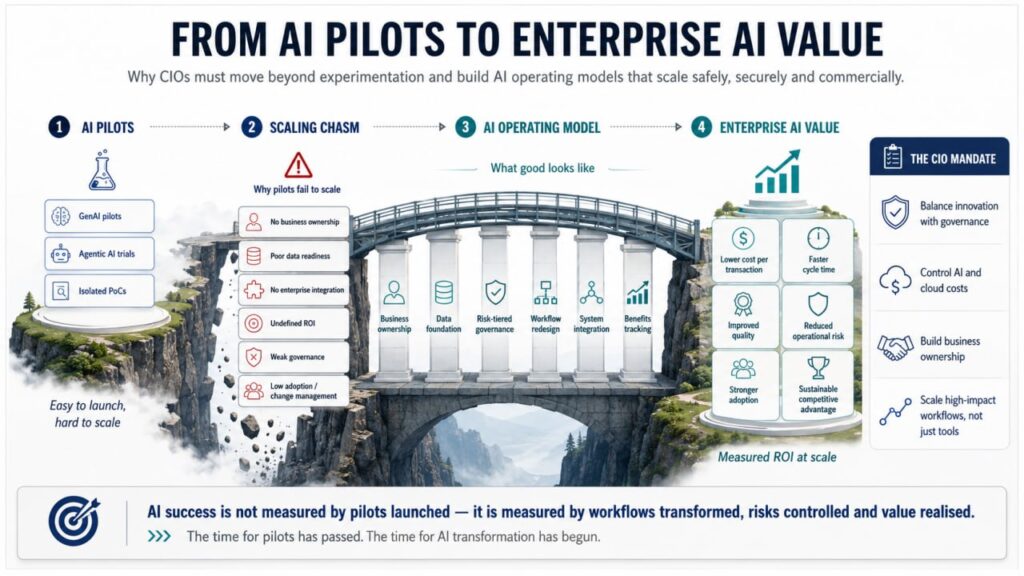
Opening: The Pilot Paradox AI pilots are easy. AI value is hard. This statement has become the unspoken truth in enterprise technology over the past eighteen months. Walk into any boardroom across the Middle East, Asia-Pacific, or North America, and you’ll find the same story: an organisation has deployed generative AI and agentic AI initiatives, launched multiple proof-of-concept projects, perhaps even hired dedicated AI teams. Yet when the CFO asks where the measurable business value is, the room goes quiet. The statistics tell a sobering story. Recent CIO research highlights that operationalising AI, establishing robust AI governance, ensuring data readiness, maintaining cybersecurity posture, and controlling costs are now board-level priorities. Cybersecurity remains the top CIO concern, followed closely by operationalising AI and data strategy. The challenge is no longer whether enterprises should adopt AI—that question was answered two years ago. The challenge is how to make AI work. This is not a technology problem. It is an operating model problem. Why AI Pilots Fail to Scale: The Root Causes Most enterprises fail to realise enterprise-wide value from AI pilots for a remarkably consistent set of reasons. Understanding these failure patterns is the first step toward building sustainable AI at scale. The Lack of Business Ownership The first and most critical failure point is the absence of genuine business ownership. Too many AI initiatives are launched by the technology function, often with enthusiasm from Chief Technology Officers or innovation teams, but without a clear business sponsor who owns the outcomes. When pilot projects deliver promising results in controlled environments, there is no senior business leader with the budget, authority, and accountability to champion the transition to production. This creates a dangerous dynamic. The technology team can demonstrate that the AI system works. Still, without business ownership, there is no one to advocate for the resources, process changes, governance approvals, and change management required to scale. The AI innovation becomes a laboratory curiosity rather than a business transformation initiative. Pilot success does not automatically translate to production deployment because the incentives, authorities, and governance structures are fundamentally misaligned. Inadequate Data Preparation and Governance A second critical failure is underestimating the complexity of data preparation. Generative AI and agentic AI systems require clean, well-structured, governed data. Most enterprises discover during the pilot phase that their data landscape is fragmented across legacy systems, inconsistently defined, poorly documented, and sometimes duplicated or stale. The pilot can work around these limitations. A small team can manually curate datasets, suppress noise, and work in a controlled environment. But scaling to enterprise-wide deployment requires fundamental data quality management, master data governance, data lineage, and compliance frameworks. This work is unglamorous, lengthy, and expensive. Many organisations abandon scaling plans when they confront the true scope of data work required. Moreover, without clear data governance established from the outset, pilot deployments often violate regulatory requirements, create audit risks, and leave organisations exposed to data privacy and security incidents. By the time governance frameworks are built, the damage to organisational appetite for AI expansion is already done. No Clear Integration into Enterprise Systems A third failure pattern is the isolation of AI systems from core enterprise architecture. Pilots often run on standalone platforms, fed by manually extracted data, with outputs delivered via email, dashboards, or APIs that are not integrated into the systems of record. When scaling, organisations must integrate AI systems into enterprise workflows—including ERP platforms, HCM systems, customer data platforms, and financial systems. This integration work is complex, requires changes to core business processes, and demands coordination between technology teams and business stakeholders. Many pilots never transition to this phase because the effort is underestimated or the business case for integration is unclear. Undefined Measurable ROI and Value Streams Perhaps the most damaging failure is the absence of clear, measurable ROI metrics established at the outset. Many pilots are launched with aspirational language—”improve efficiency,” “enhance decision-making,” “better customer experience”—without defining what these mean in financial or operational terms. When the time comes to scale, the business cannot articulate whether the pilot actually delivered value, whether that value is sustainable, or whether the cost of production deployment is justified. This creates a credibility gap. Executive leaders have become sceptical of AI promises; they want proof, not pilots. Missing Governance and Risk Frameworks A final critical gap is the absence of governance structures designed specifically for AI systems. Traditional IT governance does not adequately address the unique risks of AI systems: model drift, data bias, regulatory compliance, explainability requirements, liability for errors, and unintended downstream consequences. Pilots often operate in a governance vacuum. Once enterprises recognise that they need AI governance—frameworks for model monitoring, retraining, access controls, audit trails, human oversight, and regulatory compliance—many realise the scope of governance work required and pull back from scaling plans. The result is that organisations that should be at scale remain in the pilot phase, unable to move forward. The CIO’s New Challenge: Balancing Innovation with Governance The role of the Chief Information Officer has fundamentally changed. Historically, CIOs managed stability, security, and efficiency. Today’s CIOs must balance innovation velocity with risk management, security with enabling business agility, cost control with investment in capabilities that competitors are also pursuing. This balancing act is extraordinarily challenging, particularly in regulated industries like financial services and government. The pressure to innovate and adopt AI is intense—customers expect modern systems, competitors are moving fast, and board members are asking about AI strategy. Yet the risk of deploying immature AI systems into critical business processes is equally intense. The Innovation-Governance Tension The tension between innovation and governance is real and not easily resolved. Pure governance approaches kill innovation by requiring exhaustive approvals, documentation, and compliance frameworks before any AI experiment can proceed. Pure innovation approaches risk regulatory violations, operational failures, security breaches, and reputation damage. The solution is not to choose one over the other, but to design AI operating models that enable experimentation within a framework of managed risk. This requires several key elements: Sandbox environments where
ERP Modernisation Is Becoming an AI Readiness Test
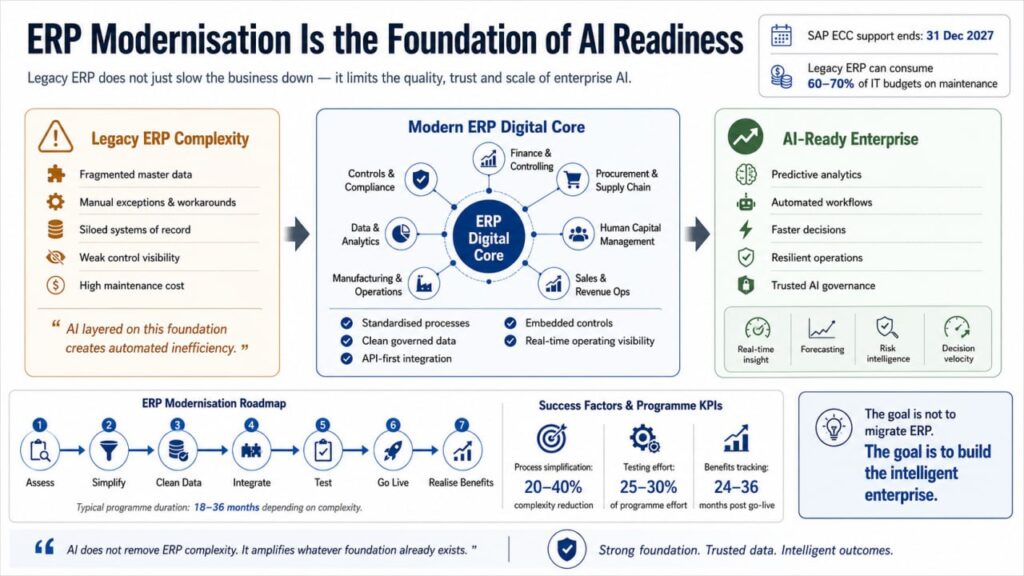
A Strategic Imperative for Enterprise Leaders in 2026 and Beyond Executive Summary Enterprise Resource Planning (ERP) modernisation has transcended its traditional role as a back-office technology initiative. In 2026, it has evolved into a fundamental strategic decision that determines an organisation’s ability to harness artificial intelligence effectively. As SAP ECC mainstream support approaches its end date of December 31, 2027, enterprise leaders face a critical juncture. This is not simply a technology migration challenge—it is a business transformation imperative that will shape competitiveness, operational resilience, and AI readiness for the next decade. The central thesis is straightforward yet profound: organisations that attempt to layer AI atop legacy ERP complexity will achieve only automated inefficiency. Those that use ERP modernisation as an opportunity to redesign their operating model fundamentally will emerge as intelligent enterprises capable of real-time decision-making, predictive analytics, and adaptive operations. Why This Moment Matters Now The confluence of three critical factors has created urgency around ERP modernisation in 2026: First, SAP has announced the definitive end of mainstream support for ECC on December 31, 2027. This is not a soft deadline. After this date, security patches, functional enhancements, and vendor support cease. For enterprises running complex ERP environments subject to regulatory requirements—particularly in financial services, healthcare, energy, and government sectors—this poses a genuine business risk. The cost of remediation increases exponentially as the deadline approaches. Organisations waiting until 2027 to plan their migration face compressed timelines, inflated vendor costs, scarcity of skilled resources, and insufficient time for proper change management. Several Fortune 500 companies found themselves with extended implementations and billions in unplanned costs when they delayed decisions beyond 2025. Second, the competitive pressure to leverage AI has become relentless. Across sectors, organisations are recognising that AI-driven decision-making, predictive analytics, and automated workflows represent genuine competitive advantages. However, AI’s effectiveness is entirely constrained by data quality, process clarity, and integration architecture. Poor data creates biased algorithms. Fragmented processes create blind spots in automation. Weak integration creates siloed insights. In short, you cannot build a superior AI operating model on an inferior ERP foundation. Financial institutions deploying AI for credit risk models, manufacturers implementing predictive maintenance, retailers using demand forecasting—all require the clean, integrated data foundation that only modernised ERP systems provide. Third, the cost of inaction has become undeniable. Legacy ERP systems consume a disproportionate share of IT budgets for maintenance, workaround management, and shadow IT. The opportunity cost of delaying modernisation—measured in forgone automation, process improvement, and analytical capability—often exceeds the investment cost of migration itself. Industry research suggests legacy ERP systems consume 60-70% of IT budgets for maintenance, leaving only 30-40% for innovation. Modern cloud ERP reverses this ratio. The Current State: Why Legacy ERP Environments Fail AI Many large enterprises operate within ERP landscapes shaped by decades of customisation, organisational change, system integration, and the accumulation of workarounds. Characteristically, these environments feature: Data Quality Issues: Master data—customer, product, vendor, GL account hierarchies—often lack standardisation, contain duplicates, suffer from inconsistent naming conventions, and carry significant historical baggage. A multinational manufacturing company might have the same vendor represented 47 different ways across regional ERP instances, resulting in incorrect supplier performance metrics, missed volume discounts, and fragmented supply chain visibility. When organisations attempt to train AI models on such data, the models inherit these defects, producing biased or unreliable predictions. Process Complexity: Legacy ERP environments typically feature numerous manual interventions, exception-handling procedures, approval chains that bypass system controls, and informal workarounds outside documented process flows. These hidden workflows are often unknown to process improvement teams, making true process redesign nearly impossible. A large bank discovered during process assessment that its accounts payable function had 47 exception-handling procedures outside the primary three-step documented process. These exceptions consumed more effort than the documented process itself. Integration Fragmentation: Data often exists in multiple systems of record—ERP holds some truth, finance systems hold another, supply chain holds another, sales holds yet another. This fragmentation prevents the real-time, unified view of the business that AI systems require. Reconciliations become manual, time-consuming, and error-prone. A global industrial company maintained 23 different data sources for product master data, resulting in 10-15 hours per week of reconciliation work and creating blind spots in product profitability analysis. Control Weaknesses: Years of regulatory change, M&A activity, and operational pressure often result in control frameworks that are documented but not consistently enforced. Compliance testing becomes laborious. The trust in data diminishes. Risk appetite declines because the organisation cannot confidently assert that its data reflects economic reality. Auditors increasingly qualify their opinions when they lack confidence in the control environment that supports financial data. Attempting to introduce AI automation on top of this foundation produces what can only be described as “automated inefficiency”—processes run faster but continue to produce the same errors, inefficiencies, and blind spots they always have. The cost of automation scales linearly with the cost of legacy complexity. ERP as the Digital Core: Rethinking the Scope Successful ERP modernisation requires a fundamental reframing of ERP’s role within the enterprise architecture. Rather than viewing ERP as a back-office finance and operations system, modern ERP must be positioned as the digital core of the entire business. This core connects and orchestrates: Finance and Controlling: Real-time GL posting, statutory accounting, management reporting, cash visibility, predictive financial modelling, and automated reconciliations Procurement and Supply Chain: Sourcing, purchase-to-pay, supplier management, inventory optimisation, demand sensing, and supply chain risk management Human Capital Management: Workforce planning, compensation, workforce analytics, skills mapping, succession planning, and organisational design Sales and Revenue Operations: Order-to-cash, customer master data, revenue recognition, pricing analytics, and customer profitability analysis Manufacturing and Operations: Production planning, quality management, asset management, predictive maintenance, and yield optimisation Data and Analytics: Master data management, integration architecture, data governance, real-time analytics, and AI model deployment Controls and Compliance: Access governance, audit trails, exception management, regulatory compliance, fraud detection, and cybersecurity When ERP is understood in this integrated way, modernisation becomes far more than a technology project. It becomes a strategic redesign of how the enterprise operates,