Opening: The Pilot Paradox
AI pilots are easy. AI value is hard.
This statement has become the unspoken truth in enterprise technology over the past eighteen months. Walk into any boardroom across the Middle East, Asia-Pacific, or North America, and you’ll find the same story: an organisation has deployed generative AI and agentic AI initiatives, launched multiple proof-of-concept projects, perhaps even hired dedicated AI teams. Yet when the CFO asks where the measurable business value is, the room goes quiet.
The statistics tell a sobering story. Recent CIO research highlights that operationalising AI, establishing robust AI governance, ensuring data readiness, maintaining cybersecurity posture, and controlling costs are now board-level priorities. Cybersecurity remains the top CIO concern, followed closely by operationalising AI and data strategy. The challenge is no longer whether enterprises should adopt AI—that question was answered two years ago. The challenge is how to make AI work.
This is not a technology problem. It is an operating model problem.
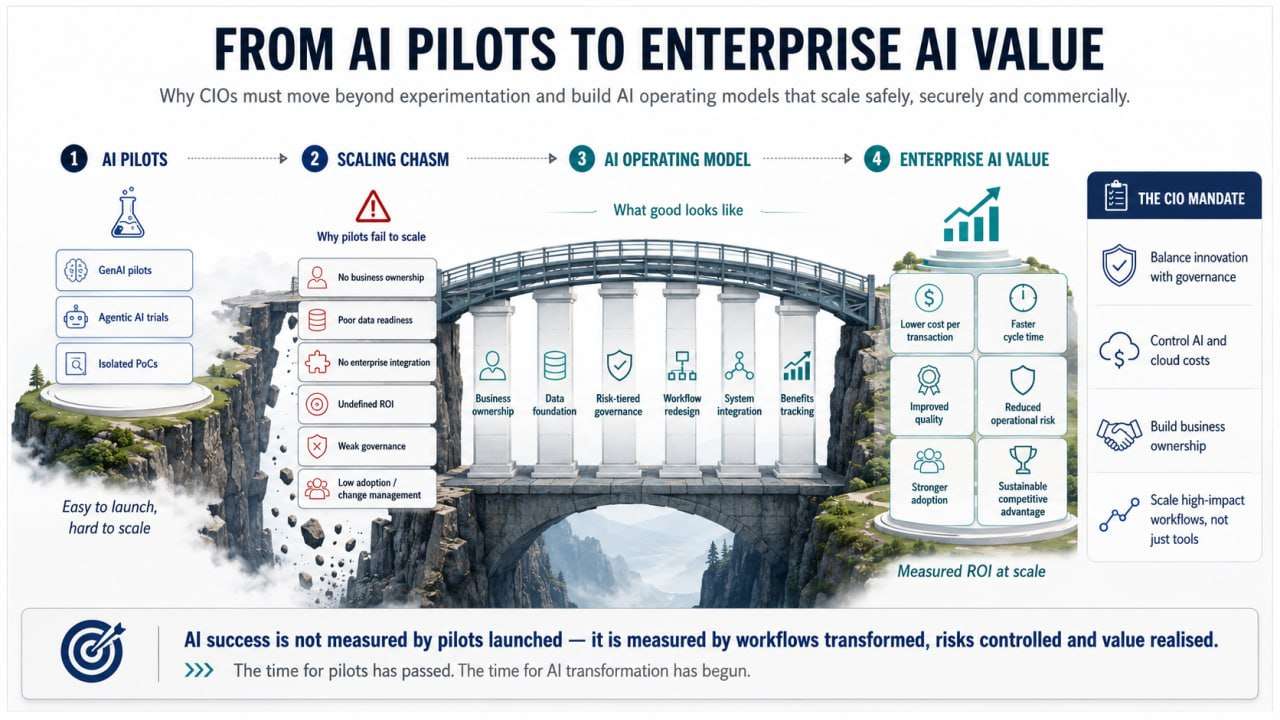
Why AI Pilots Fail to Scale: The Root Causes
Most enterprises fail to realise enterprise-wide value from AI pilots for a remarkably consistent set of reasons. Understanding these failure patterns is the first step toward building sustainable AI at scale.
The Lack of Business Ownership
The first and most critical failure point is the absence of genuine business ownership. Too many AI initiatives are launched by the technology function, often with enthusiasm from Chief Technology Officers or innovation teams, but without a clear business sponsor who owns the outcomes. When pilot projects deliver promising results in controlled environments, there is no senior business leader with the budget, authority, and accountability to champion the transition to production.
This creates a dangerous dynamic. The technology team can demonstrate that the AI system works. Still, without business ownership, there is no one to advocate for the resources, process changes, governance approvals, and change management required to scale. The AI innovation becomes a laboratory curiosity rather than a business transformation initiative. Pilot success does not automatically translate to production deployment because the incentives, authorities, and governance structures are fundamentally misaligned.
Inadequate Data Preparation and Governance
A second critical failure is underestimating the complexity of data preparation. Generative AI and agentic AI systems require clean, well-structured, governed data. Most enterprises discover during the pilot phase that their data landscape is fragmented across legacy systems, inconsistently defined, poorly documented, and sometimes duplicated or stale.
The pilot can work around these limitations. A small team can manually curate datasets, suppress noise, and work in a controlled environment. But scaling to enterprise-wide deployment requires fundamental data quality management, master data governance, data lineage, and compliance frameworks. This work is unglamorous, lengthy, and expensive. Many organisations abandon scaling plans when they confront the true scope of data work required.
Moreover, without clear data governance established from the outset, pilot deployments often violate regulatory requirements, create audit risks, and leave organisations exposed to data privacy and security incidents. By the time governance frameworks are built, the damage to organisational appetite for AI expansion is already done.
No Clear Integration into Enterprise Systems
A third failure pattern is the isolation of AI systems from core enterprise architecture. Pilots often run on standalone platforms, fed by manually extracted data, with outputs delivered via email, dashboards, or APIs that are not integrated into the systems of record.
When scaling, organisations must integrate AI systems into enterprise workflows—including ERP platforms, HCM systems, customer data platforms, and financial systems. This integration work is complex, requires changes to core business processes, and demands coordination between technology teams and business stakeholders. Many pilots never transition to this phase because the effort is underestimated or the business case for integration is unclear.
Undefined Measurable ROI and Value Streams
Perhaps the most damaging failure is the absence of clear, measurable ROI metrics established at the outset. Many pilots are launched with aspirational language—”improve efficiency,” “enhance decision-making,” “better customer experience”—without defining what these mean in financial or operational terms.
When the time comes to scale, the business cannot articulate whether the pilot actually delivered value, whether that value is sustainable, or whether the cost of production deployment is justified. This creates a credibility gap. Executive leaders have become sceptical of AI promises; they want proof, not pilots.
Missing Governance and Risk Frameworks
A final critical gap is the absence of governance structures designed specifically for AI systems. Traditional IT governance does not adequately address the unique risks of AI systems: model drift, data bias, regulatory compliance, explainability requirements, liability for errors, and unintended downstream consequences.
Pilots often operate in a governance vacuum. Once enterprises recognise that they need AI governance—frameworks for model monitoring, retraining, access controls, audit trails, human oversight, and regulatory compliance—many realise the scope of governance work required and pull back from scaling plans. The result is that organisations that should be at scale remain in the pilot phase, unable to move forward.
The CIO’s New Challenge: Balancing Innovation with Governance
The role of the Chief Information Officer has fundamentally changed. Historically, CIOs managed stability, security, and efficiency. Today’s CIOs must balance innovation velocity with risk management, security with enabling business agility, cost control with investment in capabilities that competitors are also pursuing.
This balancing act is extraordinarily challenging, particularly in regulated industries like financial services and government. The pressure to innovate and adopt AI is intense—customers expect modern systems, competitors are moving fast, and board members are asking about AI strategy. Yet the risk of deploying immature AI systems into critical business processes is equally intense.
The Innovation-Governance Tension
The tension between innovation and governance is real and not easily resolved. Pure governance approaches kill innovation by requiring exhaustive approvals, documentation, and compliance frameworks before any AI experiment can proceed. Pure innovation approaches risk regulatory violations, operational failures, security breaches, and reputation damage.
The solution is not to choose one over the other, but to design AI operating models that enable experimentation within a framework of managed risk. This requires several key elements:
Sandbox environments where teams can experiment rapidly with new AI models and techniques, with clear constraints around data access, compute resources, and output scope. These sandboxes enable innovation while preventing unbounded risk.
Clear escalation and approval pathways that allow lower-risk experiments to proceed with lightweight governance, while higher-risk changes (those affecting customer data, financial processes, regulatory compliance) require deeper review and approval.
Automated governance controls embedded into the AI pipeline itself—data quality checks, model fairness assessments, anomaly detection—rather than relying solely on human review.
Living documentation and playbooks that capture what good looks like and enable teams to move quickly while maintaining consistency and reducing repeated governance efforts.
Cost Control and Commercial Sustainability
A second dimension of the CIO’s new challenge is cost control. Generative AI and advanced analytics require significant compute resources. Cloud spending can spiral quickly if not actively managed. Moreover, the licensing models for AI platforms, services, and tools are still evolving and often opaque.
CIOs must ensure that AI investments deliver returns commensurate with their cost. This requires rigorous cost attribution, benchmarking against peer organisations, and clear decisions about build, buy, or partner. It also requires disciplined portfolio management—not every AI idea should be funded, and some pilots should be discontinued when benefits do not justify the expense.
Business Adoption and Change Management
A third, often-overlooked dimension is the challenge of change management and adoption. Technical AI deployments can be successful from a systems perspective but fail to drive business value if end users do not adopt new processes, understand how to use the systems, or trust AI-generated insights.
CIOs must ensure that their organisations invest in change management, training, and adoption support alongside AI technical deployments. This means working closely with business leaders, designing workflows that integrate AI naturally into existing processes, and building feedback mechanisms to understand where adoption is falling short.
Workflow Redesign: From Chatbot Thinking to Transformation
One of the most common misconceptions about AI is that the goal is to automate small tasks. “Let’s deploy a chatbot to handle customer service inquiries.” “Let’s use AI to draft email responses.” “Let’s automate routine data entry.”
These are valid applications of AI technology, but they represent a fraction of the transformational potential. The more powerful application of agentic AI is workflow redesign—examining end-to-end business processes and fundamentally reimagining how they operate when augmented by AI capabilities.
Finance Process Transformation
Consider finance operations. Traditional accounts payable processes involve multiple manual steps: invoice receipt, entry into the system, matching against purchase orders and receipts, exception handling, approval, and payment. Each of these steps is labour-intensive and error-prone.
An agentic AI system deployed in finance can fundamentally reshape this workflow. An intelligent agent can receive invoices in multiple formats (email, portal, EDI), extract key data (vendor, amount, date, invoice number), validate against purchase orders and receipts, flag exceptions for human review, route approvals based on business rules, and even initiate payment. The human finance team moves from data processing to exception management and strategy. Cost per transaction falls dramatically, cycle time improves, and the error rate declines.
But this transformation only happens if the finance function and IT collaborate to redesign the workflow from the ground up. It requires changes to process discipline, system architecture, data governance, and approval authorities. It requires training finance teams to interpret and override AI-generated decisions when necessary. The payoff is substantial—but only if the organisation commits to workflow redesign, not just AI deployment.
Human Resources and Talent Management
Similar transformations are possible in human resources. Recruitment workflows can be reimagined with AI agents that screen applications, conduct initial phone interviews, schedule meetings, and prepare briefing documents for human recruiters. Employee onboarding can be partially automated through intelligent chatbots that answer policy questions and guide employees through registration processes. Performance management workflows can integrate AI-generated insights on skill gaps, career progression patterns, and attrition risk.
Again, these transformations require more than AI deployment. They require rethinking processes, addressing change management, retraining HR professionals, and establishing governance to ensure the fair and lawful use of AI in hiring and promotion decisions.
Procurement and Supply Chain
In procurement, agentic AI can transform vendor management, sourcing decisions, and purchase order processes. In the supply chain, AI can optimise inventory levels, predict disruptions, and guide demand planning. In customer service, AI agents can handle more complex queries, escalate to human agents when necessary, and provide personalised recommendations.
The common thread across all these examples is that the organisations capturing the greatest value from AI are not focusing on individual tasks or chatbots. They are redesigning workflows, redefining roles, and rebuilding their operating models to leverage AI as a decision-making and execution partner, not just a cost-reduction tool.
Governance Must Be Built into the AI Operating Model
If there is a single lesson that successful enterprises have learned, it is that governance cannot be retrofitted. AI governance must be designed into the operating model from the beginning.
The Core Elements of AI Governance
Effective AI governance frameworks typically include several core elements:
Model ownership and accountability. Each AI model must have a clear owner—a business leader or technical leader accountable for the model’s performance, behaviour, and outcomes. This owner must be empowered to make decisions about model retraining, retirement, or significant changes.
Data provenance and quality assurance. The source, lineage, and quality of data feeding into AI systems must be documented and monitored. Data quality checks must be automated and built into the pipeline. Organisations must be able to trace any AI output back to its underlying data sources.
Fairness and bias testing. AI systems can inadvertently discriminate against protected groups or perpetuate historical biases in training data. Fairness testing and bias mitigation must be built into model development and ongoing monitoring.
Explainability and interpretability. Organisations must understand how and why AI systems make decisions, particularly when those decisions affect customers, employees, or business outcomes. This does not always require perfect explainability, but it requires sufficient transparency for human decision-makers to understand and override AI recommendations when appropriate.
Model monitoring and drift detection. AI models trained on historical data can degrade over time as the underlying business environment or data characteristics change. Continuous monitoring must detect model drift and trigger retraining when necessary.
Access controls and data privacy. AI systems must enforce role-based access controls, ensure compliance with data privacy regulations (e.g., GDPR and local equivalents), and prevent unauthorised use of sensitive data. This is particularly critical for systems that process customer data, financial information, or employee records.
Audit trails and explainability for regulators. Organisations in regulated industries must maintain detailed logs of AI decisions and be able to explain to regulators how and why specific decisions were made. This is particularly important in financial services, where regulators are increasingly focused on algorithmic accountability.
Human oversight and escalation. For high-risk decisions, human review must be built into the process. AI can make recommendations, but humans must remain in control of final decisions with the ability to override AI guidance.
Implementing Governance Without Killing Innovation
The challenge is implementing these governance elements rigorously while still enabling rapid innovation and experimentation. The solution is a layered approach:
Low-risk experimentation (proof-of-concept projects using non-sensitive data with limited deployment scope) requires lightweight governance—basic documentation, a clear experimental scope, and defined decision criteria for moving to the next phase.
Medium-risk deployment (pilots using business data that affect employee or internal processes, with limited customer impact) requires more rigorous governance—data quality validation, fairness testing, model monitoring, access controls, and clear escalation paths.
High-risk deployment (systems affecting customer decisions, financial processes, regulated activities, or sensitive employee data) requires comprehensive governance—all of the above, plus regulatory compliance reviews, audit trails, human oversight, and potentially external audits.
This layered approach prevents governance from becoming a blanket bureaucracy that stifles innovation while ensuring that high-risk AI deployments are appropriately controlled.
What Good Looks Like: From Concept to Scale
Organisations that are successfully scaling AI from pilots to enterprise deployment share several characteristics:
Clear Business Value Streams
They begin not with technology, but with business value streams. They ask: “Which business processes, if improved by AI, would have the most material impact on our financial performance, customer satisfaction, or competitive position?”
They then map each value stream in detail, identify where AI could help, and estimate the potential impact. This ensures that AI investments are targeted at high-impact opportunities and that success metrics are clear from the start.
Dedicated AI Use-Case Portfolios
Rather than treating each AI project in isolation, they create portfolios of related use cases within each business function. This enables economies of scale in data preparation, governance, and platform investment. It also creates clear priorities for resource allocation and sequencing.
Successful organisations often create tiered portfolios: immediate high-impact opportunities for deployment now; medium-term opportunities requiring process redesign or data work; longer-term exploration of emerging techniques and applications.
Clear Ownership and Accountability
Every AI use case has a business owner (not just a technical owner) accountable for value realisation. This owner has authority over process changes, training investments, and success metrics. Without this, pilot successes do not translate to business outcomes.
Rigorous Benefits Measurement
Before deployment, success metrics are defined. After deployment, benefits are measured rigorously against the baseline. This creates accountability, enables course correction, and builds the business case for scaling to additional use cases.
Common success metrics include cost reduction (cost per transaction, labour hours saved), quality improvement (error rates, defect rates), cycle time improvement, revenue impact, and customer satisfaction metrics. These should be quantified in advance and measured monthly post-deployment.
Phased Scaling with Feedback Loops
Rather than attempting to scale pilots globally immediately, successful organisations deploy use cases in phases. An initial pilot in one region or function is followed by expansion as learnings are captured and governance is refined. This reduces risk and provides opportunities to adjust the operating model before broader rollout.
Investment in Data Architecture and Governance
Organisations at scale recognise that their data is their competitive advantage. They invest in data platforms, master data management, data governance structures, and data quality frameworks as foundational investments that enable multiple AI use cases.
This investment is not glamorous, but it is essential. Organisations without this foundation eventually hit the scaling ceiling and revert to manual processes or delayed deployments.
Talent and Skill Development
Scaling AI requires talent—data scientists, machine learning engineers, governance specialists, and change managers. Successful organisations invest in recruiting this talent, retaining key people, and building internal capability rather than relying entirely on external consultants.
They also invest in reskilling existing employees so that business process owners and finance teams understand AI well enough to work effectively with technical teams.
The Path Forward for CIOs
For Chief Information Officers in the GCC region and globally, the imperative is clear: move beyond pilots. The organisations that will win in the next five years are not those that run the most AI pilots; they are those that scale AI systematically across their organisations.
This requires several steps:
First, establish clear governance frameworks and operating models. Define what governance layers look like for different risk levels. Make decisions about centralised versus decentralised AI ownership. Establish decision-making authorities and approval pathways. Get these frameworks in place before scaling, not after.
Second, invest in foundational data and technology infrastructure. Build data platforms, master data management, and governance tools. These investments take time and cost money, but they are essential prerequisites for scaling.
Third, identify and sequence high-impact AI use cases. Create a business-driven portfolio of opportunities. Prioritise based on impact potential, data readiness, and governance complexity. This creates a multiyear roadmap for AI value creation.
Fourth, build business ownership and change management capabilities. Partner with business leaders to ensure every major AI initiative has clear business sponsorship, outcomes ownership, and change management support. Without this, technical deployments do not translate to business value.
Fifth, develop talent and capability. Recruit and retain AI talent. Invest in reskilling existing employees. Build partnerships with technology providers and consultants where needed, but develop internal capability as well.
Sixth, measure and communicate value relentlessly. Establish clear metrics. Measure results. Share results with business leaders and boards. Build momentum by demonstrating and celebrating value realisation.
Conclusion: The Real Question
The real question facing CIOs is no longer: “Can we use AI?” That question was answered two years ago. The answer is yes, and competitors are already doing it.
The real question is: “Can we safely, securely, and commercially scale AI across our enterprise to create sustainable competitive advantage?”
This is a different challenge entirely. It requires moving beyond experimentation into disciplined, governance-driven, value-focused deployment. It requires business ownership and collaboration, not just technology prowess. It requires patience to build foundational capabilities and investment in processes and governance that are not visible to the board but enable scaling.
The organisations that answer this question well will emerge as industry leaders. Those that remain stuck in the pilot phase will find themselves increasingly left behind.
The time for pilots has passed. The time for transformation has begun. The question is whether your organisation is ready to move forward.