The Comfort of Success: A Dangerous Assumption
There is a particular comfort that comes with running a successful business for decades. Markets have been kind. The founder has built something substantial. Cash flows are healthy. The customer base is loyal. Employees have been with the company for years. Suppliers know how to work with the business. The regulatory environment is stable.
The business has succeeded by doing what it has always done.
This success creates a particularly dangerous psychological dynamic: the assumption that continued success requires nothing more than maintaining current approaches.
This assumption is understandable. It is also potentially catastrophic.
Because the external environment in which family businesses operate is not static. Markets are changing. Competition is intensifying. Technology is disrupting traditional business models. Customer preferences are evolving. Regulatory frameworks are becoming more stringent. The labour market is shifting. Generational expectations are changing.
Stability and unchanging operations, which were the source of past success, become the source of future decline.
The Risk Landscape: What Changes and What It Means
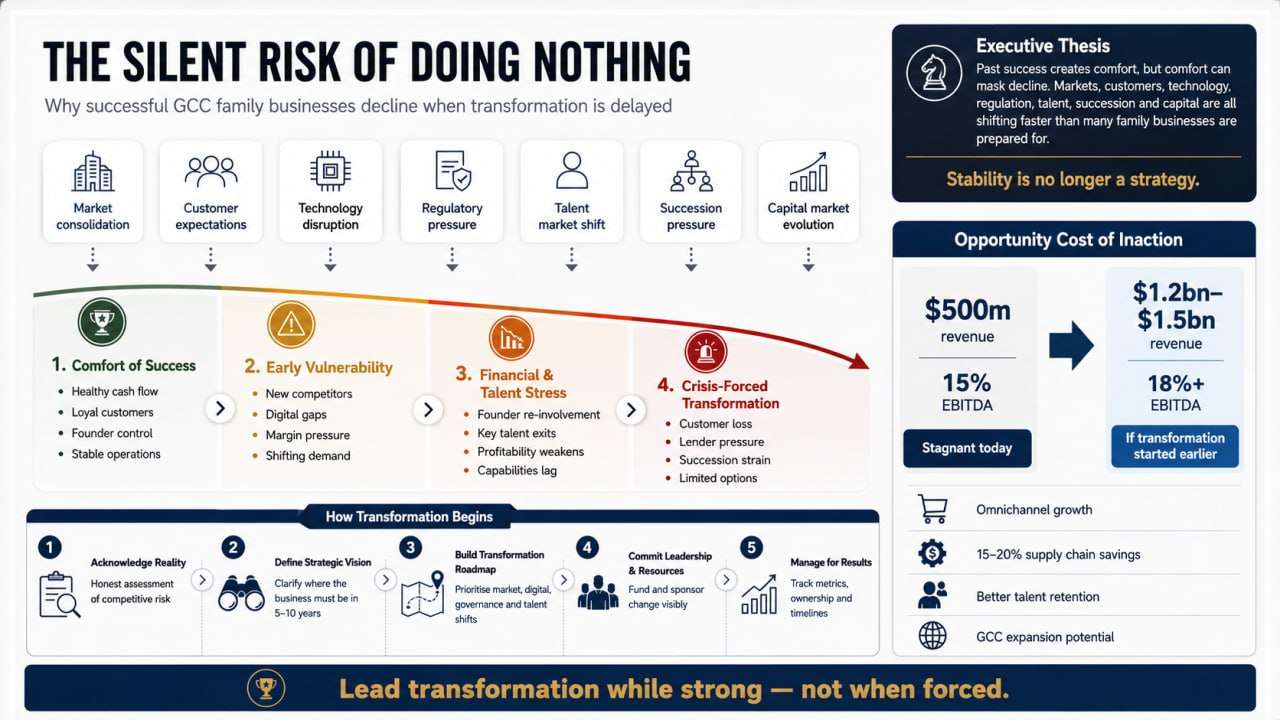
To understand the silent risk of inaction, we must examine the external environment changes that are transforming business conditions across the GCC:
Market Consolidation and New Competition
For decades, many family businesses operated in industries with a stable, predictable competitive landscape. The top three players remained the top three players. New competitors entered rarely and with difficulty. Margins were sustainable.
This is changing. Several forces are driving market disruption:
Global multinationals are increasingly comfortable operating in GCC markets. Walmart entered through Carrefour’s ownership. Amazon is building regional logistics capabilities. FMCG multinationals are improving distribution directly, reducing dependence on traditional distributors. Professional management is becoming table stakes, not a competitive advantage.
Technology-enabled competitors are emerging. E-commerce platforms are consolidating retail, eating into traditional retail margins. Digital marketplaces are disintermediating traditional distribution models. FinTech platforms are competing with traditional financial services.
Regional players from adjacent markets are expanding across borders. An excellent distributor from Egypt or Saudi Arabia sees an opportunity in the UAE market and enters with modern approaches and lower cost structures.
Within the GCC, family businesses are consolidating, creating super-competitors with greater scale, specialised functions, and operational sophistication.
The consequence: The stable competitive environment that has characterised many industries is becoming unstable. A secure market position is becoming vulnerable. A company that was the clear category leader is facing new competitors and margin pressure.
A family business that assumes it will maintain its market position through existing approaches is operating from a dangerous assumption.
Changing Customer Expectations
Customer expectations are evolving in ways that many traditional family businesses have not fully internalised.
Digital-native customers (typically younger, educated abroad, exposed to global consumer experiences) have different expectations:
- Seamless omnichannel experience (online and offline integration)
- Responsive customer service (24/7, multiple channels)
- Transparency and data privacy
- Sustainable and ethical sourcing
- Personalisation based on purchase history
- Fast delivery and easy returns
Traditional family businesses that excel at personal relationships and in-person service often lag in digital capabilities and omnichannel experience. A retail business that was world-class in in-store experience may be fundamentally unprepared for e-commerce competition.
Similarly, B2B customer expectations are evolving. Large corporate customers increasingly demand integration with digital platforms, real-time visibility into supply chains, and data-driven reporting. A distribution company that sold through personal relationships and phone orders is competing with suppliers that offer cloud-based ordering platforms and automated fulfilment.
Customers are not loyal forever, and not to traditional approaches. Loyalty is to companies that meet evolving expectations. A business that ignores these changes loses market share to more responsive competitors.
Technological Disruption
The pace of technology change is accelerating. Technologies that were science fiction a decade ago are now accessible and affordable:
- Artificial intelligence and machine learning are enabling the automation of tasks that require human intelligence
- Cloud computing is making enterprise software accessible to small and mid-sized companies
- Data analytics are enabling visibility and optimisation that was impossible before
- Mobile technology is enabling direct customer engagement that bypasses traditional channels
- Blockchain and distributed systems are enabling new business models (cryptocurrency, decentralised finance)
- IoT and sensors are enabling real-time visibility into physical operations
A family business that does not embrace technology will find itself unable to compete with companies that do. A manufacturing company without ERP visibility into production costs will lose margin competition to one with real-time production analytics. A retail company without e-commerce will lose market share to those with seamless digital experiences.
Technology is not a nice-to-have. It is becoming table stakes.
Regulatory and Compliance Evolution
The GCC regulatory environment is tightening. Governments are moving toward formalisation, transparency, and standardisation in ways that were not previously required.
Examples:
- Corporate governance standards: The UAE and other GCC countries are implementing or strengthening corporate governance codes. Boards must have independent directors. Executive compensation must be disclosed. Risk management frameworks must be formalised. Smaller family businesses that have operated without formal governance are finding that regulatory requirements now mandate it.
- Environmental, Social, and Governance (ESG) standards: International investors increasingly require ESG compliance. Companies are expected to manage environmental impact, ensure supply chain fairness, implement diversity, and report on social impact. Family businesses that have not internalised these expectations face reputational risk and limited access to capital.
- Tax and transfer pricing: Tax authorities globally are tightening rules around tax planning, intercompany pricing, and transfer pricing. Family business structures that were acceptable five years ago may no longer be compliant.
- Data privacy and security: Regulations like GDPR have a global reach, and GCC regulators are implementing similar standards. Companies must protect customer and employee data, obtain consent for data usage, and report breaches. A family business with minimal IT security is exposed to regulatory violations and data breach liability.
- Labour standards: Labour regulations regarding working hours, wage standards, benefits, and workplace safety are being enforced more strictly. Informal labour practices that were previously accepted are increasingly prohibited.
A family business that assumes regulatory requirements will remain static is making a dangerous assumption. Compliance is evolving, and non-compliance has increasing costs.
Talent Market Changes
The labour market is fundamentally shifting, and this has particular implications for family businesses:
Younger employees expect:
- Career development and clear advancement paths
- Meritocratic advancement (not based solely on family relationships)
- Competitive compensation (market-based, not founder discretion)
- Transparent performance expectations and feedback
- Professional development opportunities
- Work-life balance and wellness support
- Companies with a clear social purpose
Traditional family businesses that have retained employees through personal relationships, informal advancement, and family proximity are finding that this model no longer works.
Superior talent is increasingly choosing to work for professional organisations with clear career paths, competitive compensation, and recognised brands over family businesses with opaque advancement and informal processes.
The consequence: Family businesses are losing their best employees to more professional competitors. The institutional knowledge that was retained through employee loyalty is walking out the door.
Additionally, the cost of replacement talent has increased substantially. Recruiting, training, and retaining new talent requires investment in systems, processes, and compensation that traditional family businesses may not have budgeted for.
Demographic and Generational Shifts
UAE demographics are changing in ways that affect family business sustainability:
The founder generation that built family businesses is ageing. Many founders are approaching retirement or have already entered their 70s or 80s. The transition to the next generation is not a future event—it is a present event.
The next generation has different worldviews and expectations. Many have been educated internationally and worked at multinational corporations or in startup environments. They expect professional management, clear governance, transparent decision-making, and strategic clarity. They do not want to inherit a business structured entirely around the founder’s discretion.
Additionally, demographic composition in the GCC is changing. The Emirati population is growing at different rates than expatriate populations. Government policies are increasingly favouring Emiratization (employment of citizens). A family business that relies entirely on expatriate management may find regulatory expectations shifting toward citizen employment, forcing staffing changes.
Capital Market Evolution
The sources and costs of capital are evolving in ways that create pressure on family businesses:
Traditional bank financing was the primary source of growth capital for family businesses. Banks have historically been comfortable lending against family business cash flows and founder guarantees.
This is changing. Banks are increasingly requiring formalised governance, professional management, and transparent financial reporting as conditions of lending. A bank will lend less aggressively to a founder-dependent business than to one with professional management and clear succession plans.
Alternative capital sources are becoming available. PE firms, impact investors, and institutional lenders are providing capital to family businesses that meet certain criteria. But these investors require professionalisation as a condition of investment.
The consequence: A family business that remains entirely founder-dependent will find that capital becomes more expensive and less available. A business that professionalises will have a lower cost of capital and greater financing options.
The Erosion Cycle: How Success Becomes Vulnerability
Understanding these individual changes is important. Understanding how they interact to create a broader erosion cycle is critical.
Stage 1: Early Vulnerability
A family business that ignores changing market conditions, customer expectations, or technological disruption gradually loses its competitive position. Market share erodes. Margins compress. The dominant business faces new, more professional competitors.
At this stage, the business is still profitable and healthy by historical standards. But trend lines are concerning.
Many family business leaders respond by tightening operations and cutting costs. “We need to focus on our core business.” “We need to improve margins.” “We need to do more with less.”
These are natural responses, but they are insufficient in the face of structural changes in the market. Cost-cutting does not address the underlying competitive vulnerability.
Stage 2: Financial Stress
As market share erodes and margins compress, financial performance deteriorates. Robust cash flow becomes concerning. The business that has always generated healthy profit margins is suddenly facing pressure on profitability.
The founder’s response is typically to increase personal involvement. The founder focuses on “getting the business back on track.” Key decisions that had been delegated return to the founder’s desk.
This might provide temporary relief, but it does not address the fundamental competitive problem. The business needs to evolve, not to work harder.
Additionally, increased founder involvement often exacerbates talent issues. Employees who were already frustrated by a lack of clarity and advancement become even more frustrated by the founder’s micromanagement. Superior talent leaves.
Stage 3: Succession Crisis
By the time the founder is ready to step back (due to ageing or personal choice), the business is often in a precarious position. The successor inherits a business facing competitive pressure, financial stress, and the loss of key talent, and lacking the infrastructure to address these challenges.
The successor faces a choice:
- Attempt to stabilise the business through cost-cutting and founder-like personal involvement (which perpetuates the problem)
- Attempt a rapid transformation to address competitive challenges (which is high-risk and requires capital)
- Accept that the business is in decline and manage for cash harvest
Many successors find themselves in a situation where none of these options is attractive.
Stage 4: Decline or Crisis Forced Transformation
If the business continues on this trajectory without intervention, it will eventually face a crisis. Market share continues to erode. Financial performance deteriorates. Lenders become concerned about loan covenants. Key customers defect. Key employees leave.
At some point, a crisis event forces transformation: a near-default, a major customer loss, a failed ERP implementation, or the founder’s sudden departure.
By this point, the options are more limited and more costly than they would have been if proactive transformation had occurred years earlier.
The Opportunity Cost of Inaction: What Was Possible
One of the underappreciated aspects of inaction is the opportunity cost—the value that could have been created but was not.
Consider a family business in retail with $500 million in annual revenue and 15% EBITDA margins (healthy by family business standards). The business has operated unchanged for 20 years.
Had the business proactively transformed 15 years ago:
- Digital transformation would have enabled omnichannel retail capabilities. The business would have captured the e-commerce market share growth that competitors captured instead.
- Supply chain modernisation would have reduced procurement costs by 15–20%, improving margins. That would be $45–60 million annually in additional cash flow.
- Talent and organisational development would have retained superior employees and attracted new talent. Operational capability would have improved, enabling expansion into adjacent categories.
- International expansion would have been possible with professional management and clear governance. The business might have expanded to other GCC countries, tripling revenue.
By the end of 15 years, had the business executed these transformations, it might be a $1.2–1.5 billion revenue business with 18%+ EBITDA margins, operating across multiple GCC countries, with professional management and clear governance.
Instead, the business remains a $500 million operation struggling with margin compression, losing market share, and facing succession challenges.
The opportunity cost is enormous. This is not a theoretical exercise. This is the reality many family businesses face.
The Strategic Imperative: Why Transformation Cannot Wait
The uncomfortable truth that every family business leader must confront is this: Stability is not a viable long-term strategy.
Markets are changing faster than they ever have. Technology is disrupting business models faster than ever. Customer expectations are evolving faster than ever. Competition is intensifying faster than it ever has.
A family business that assumes it can remain unchanged and maintain a competitive position is operating from a false premise.
The strategic imperative is clear:
Transformation is Not Optional
For any family business seeking multi-generational sustainability, transformation is not a future consideration—it is a present imperative. A business that does not transform will progressively lose competitive position, margin, market share, and attractiveness to next-generation leadership.
The Window for Proactive Transformation is Closing
The best time to transform is when the business is healthy and performing well. This is when the founder has time and attention to focus on transformation. This is when the business has capital to invest in transformation. This is when employees are optimistic and willing to embrace change.
As market pressures increase and business performance declines, the window for proactive transformation closes. Transformation becomes more expensive, more disruptive, and riskier.
Waiting for a crisis is a Losing Strategy.
Some family business leaders delay transformation, betting that “things will work out” or that the business will weather market changes through incremental adjustments. By the time crisis forces transformation, the business is often in such a poor position that transformation is either impossible or results in a diminished business.
The Path Forward: How Transformation Begins
For a family business leader who recognises that transformation is necessary, where does the change process begin?
Step 1: Acknowledge Reality
The first step is an honest assessment of the business’s competitive position, market trends, and the threats it faces. This is harder than it sounds because many family business leaders have invested decades in building the current business and are psychologically attached to current approaches.
An external perspective is invaluable here. A board advisor, external consultant, or trusted peer can help the founder acknowledge reality without it coming across as criticism.
Step 2: Define Strategic Vision
Rather than reacting to threats, proactive business leaders define where they want the business to be in 5–10 years and what the business must become to get there.
This vision should be ambitious but credible. It should excite the organisation and make clear why change is necessary.
Step 3: Develop Transformation Roadmap
A multi-year roadmap should be created outlining the key transformation initiatives required to move from the current state to the future vision. This roadmap should address market positioning, operational capabilities, governance, management, and talent.
Step 4: Commit Resources and Leadership
Transformation is not free. It requires investment in systems, external expertise, training, and management time. The founder must commit resources in a way that signals the importance of transformation.
Step 5: Manage for Results
Progress should be measured against explicit metrics and timelines. Accountability should be clear. Momentum should be maintained even when obstacles emerge.
Conclusion: The Cost of Doing Nothing
The silent risk of family businesses is not dramatic failure. It is a slow decline. It is the gradual erosion of competitive position, margins, and market share that occurs when a business assumes that past success guarantees future success.
This decline is “silent” because it does not announce itself loudly. Businesses can operate for years in a slow decline without a dramatic crisis. The founder still earns income. The business is still profitable. The decline is invisible to those not paying close attention.
Yet over a 10–20-year period, the cumulative impact is substantial. A business that was dominant in its market becomes challenged. A growing business becomes stagnant. A business that was attractive to talent becomes less attractive. A business that had expansion opportunities finds that competitors have already captured them.
For any family business leader, the question is not whether change is necessary. External forces are making it clear that change is necessary.
The question is: Will you lead that change proactively, when you have resources and time to do it well? Or will you wait until circumstances force it, when the cost is higher, and the risk is greater?
The choice is yours. But the cost of inaction grows with each passing year.