Why Family Businesses Fail at the Moment of Succession
There is a paradox at the heart of family business dynamics that few outsiders truly understand: the moment of greatest strength is often the moment of greatest vulnerability.
A first-generation founder has built a family business through sheer force of will, entrepreneurial vision, market timing, and relentless execution. The business is profitable. It is dominant in its market. It has successfully navigated economic cycles and competitive pressures. Cash flows are strong. Operations are understood intimately by the founder—not because they are documented, but because they exist in the founder’s mind.
Then the founder faces the inevitable: ageing, retirement, mortality, or the simple desire to step back.
What happens next determines whether the family business thrives for another generation or begins a slow decline into irrelevance, paralysis, or outright failure.
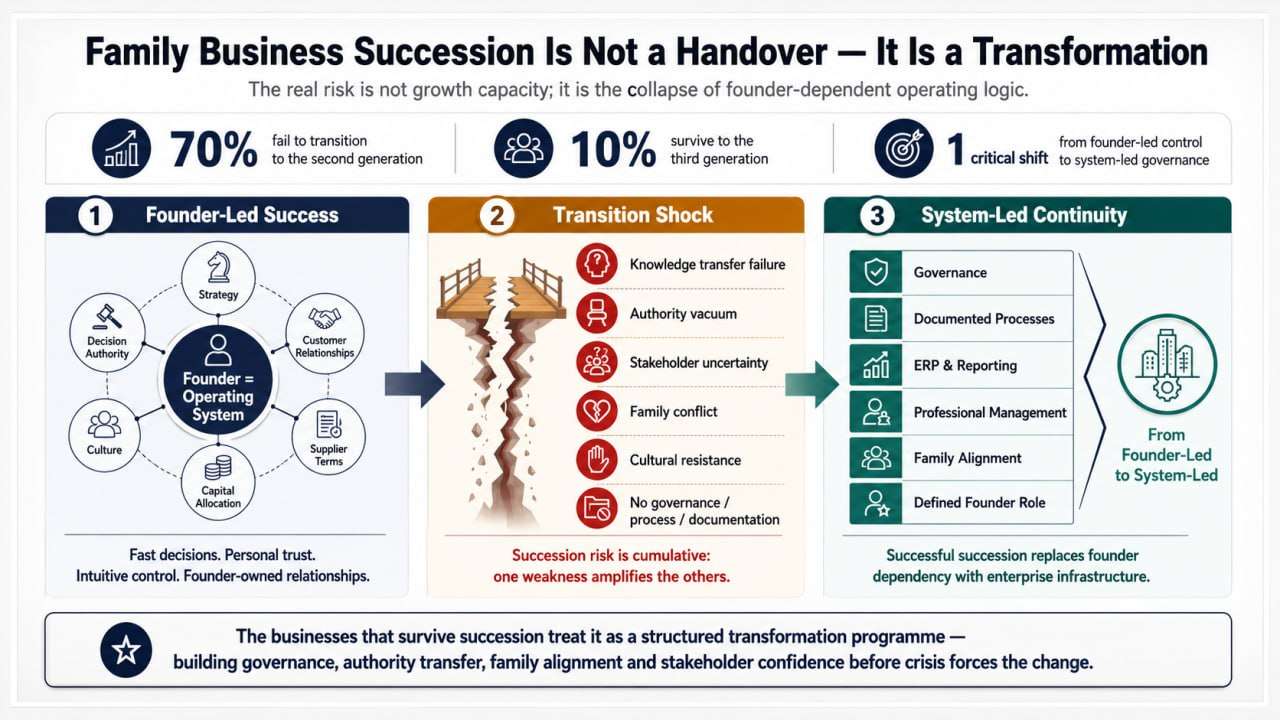
The statistics are brutal. Approximately 70% of family businesses do not successfully transition to the second generation. Of those that do, only about 10% survive to the third generation. The United Nations estimates that across the Middle East, the situation is even more difficult, with many businesses folding entirely upon the founder’s death or departure.
The prevailing assumption among external observers is that these failures stem from a lack of growth capacity, market disruption, or incompetence in the next generation. This assumption is dangerously wrong.
The real reason most family business transitions fail is not about growth. It is about transformation.
The Founder-Led Model: Elegant in Success, Brittle in Succession
To understand why transition is so difficult, we must first understand the operating model that successful first-generation family businesses have built.
The founder-led family business operates on several core principles:
Founder as CEO and Chairman: The founder is not simply the leader—the founder IS the business. Strategic decisions, major capital allocation, client relationships, key vendor negotiations, and cultural authority all flow from and return to the founder. The organisational structure exists to execute the founder’s vision, not to operate independently.
Information as Personal Possession: Critical business knowledge—customer relationships, supplier terms, pricing logic, capital structure, expansion plans, competitive positioning—exists in the founder’s head, not in documented systems. The founder possesses an information advantage that would be extraordinarily difficult to transfer.
Decision-Making Authority as Concentrated Power: Authority is not distributed through formal structures—it is concentrated in the founder. Decisions are made quickly because there is only one decision-maker. Disagreement is resolved because the founder has final authority.
Culture as Founder Personality: The organisation’s culture reflects the founder’s values, work ethic, risk tolerance, and interpersonal style. Loyalty is personal—employees work for the founder, not for the organisation.
Success Metrics as Founder Intuition: Rather than formal KPIs, dashboards, and metrics, success is measured by the founder’s intuitive sense of whether things are going well. The founder “feels” when something is off, when an opportunity is emerging, or when a market is shifting.
Capital Allocation as Founder Discretion: How cash flows are used—whether reinvested in operations, deployed into new business lines, distributed to family, or allocated to personal investments—is entirely the founder’s decision, often made informally.
This model is extraordinarily efficient. It minimises overhead, eliminates bureaucratic decision-making, and enables rapid response to market opportunities. It has been the engine of success for countless family businesses.
It is also entirely dependent on the presence and decision-making of a single individual.
The Transition Trap: What Actually Changes
When a founder steps back, and a successor takes over, what appears to be a simple transition—” the founder retires, the next generation takes over”—actually triggers systemic changes across every aspect of how the business operates.
Knowledge Transfer Failure: The first-generation successor discovers that the information they thought they had absorbed is incomplete. They understand parts of the business they worked directly with, but they lack critical context on major client relationships, vendor negotiations, supplier dependencies, historical capital decisions, and competitive positioning. The founder’s intuitive understanding of “what we are” and “who we serve” was never explicitly articulated. Now the successor must reconstruct this knowledge while running the business.
Authority Vacuum: The organisation has been trained to defer to the founder for decisions. The successor possesses formal authority but lacks the intuitive authority the founder had accumulated over decades of sound decisions. When the successor makes a decision—even a correct one—staff may second-guess it or wait to see if the founder will override it. This creates a vacuum that multiple decision-makers attempt to fill.
Stakeholder Realignment: Customers, suppliers, lenders, and government counterparties built relationships with the founder rather than with the organisation. When the successor takes over, these stakeholders immediately ask: “Can this person do what the founder did?” The answer is almost always “not yet.” This creates vulnerability, allowing competitors to approach customers, suppliers to demand renegotiation of terms, and lenders to tighten credit.
Strategic Direction Ambiguity: The founder’s strategic vision was often implicit—everyone knew what the business was trying to do because the founder communicated it through decisions and priorities. The successor, particularly if educated globally and exposed to diverse business models, may have a different strategic vision. The organisation suddenly faces a choice: Is the business what the founder built, or what the successor believes it should become?
Cultural Friction: The successor often introduces new approaches—more formal processes, different management styles, new technology, modified compensation structures. These changes, even if beneficial, are experienced as threats by staff who benefited from the founder’s culture and approach.
Family Dynamics Explosion: As the founder steps back, family members who had deferred to the founder’s authority may suddenly assert their own opinions about how the business should be run. A sibling may feel that they should have been the successor. A spouse may have different priorities. Cousins may want roles they were never considered for. The shared authority of “the founder” suddenly fragments into competing family interests.
Capital Allocation Conflict: The successor may have different views on how profits should be distributed. Should capital be reinvested aggressively for growth, or should it be distributed as dividends to family members? Should the business diversify into new sectors, or focus on the core? Should the company remain family-controlled or bring in outside investors? These decisions, which were implicit under founder leadership, have now become explicit conflicts.
Operational Formalisation Pressure: As the business grows and scales, what worked under founder leadership becomes untenable. Informal decision-making, verbal authorisation, personal relationships with key suppliers, and gentleman’s agreements all begin to fail as complexity increases. The successor faces pressure to formalise—to create processes, documentation, and governance structures. But formalisation is experienced as “loss of flexibility” and “bureaucracy” by staff accustomed to founder-led speed.
This is not a transition. This is a transformation.
The Generational Divide: Education, Exposure, and Ambition
The difficulty of family business transition is compounded by a specific generational reality that is particularly acute in the UAE and broader Middle East: the founder and successor generations often have profoundly different educational backgrounds, international exposure, and worldviews.
The first-generation founder—often someone who built the business in the 1970s, 80s, or 90s—frequently grew up in a developing UAE. They received their primary education in the Emirates, perhaps supplemented with some international exposure. They learned business through practice, not through formal education. They built their companies in an environment of rapid economic growth, limited competition, and abundant market opportunities.
The second-generation successor—often now in their 30s or 40s—grew up in a substantially wealthier UAE. They studied at international universities (typically in the UK, the US, or Canada). They spent their formative years in London, New York, Boston, or Sydney. They were exposed to global business practices, modern management theory, startup cultures, and technology-driven business models. They often interned at multinational corporations or worked in investment banking or consulting before returning to the family business.
The consequence is that the founder and successor do not think alike. They do not prioritise the same things. They do not see business challenges through the same lens.
The founder sees the family business as:
- A source of family security and wealth preservation
- A vehicle for personal achievement and legacy
- An entity to be controlled and protected
- Something to be grown organically through reinvestment
- A cash generation machine to fund family needs
The successor sees the same business as:
- A platform that is underoptimized relative to its potential
- A vehicle for professional achievement and innovation
- An entity that requires professionalisation and governance
- Something that should be scaled aggressively, potentially through external capital or M&A
- A business that should be structured for potential exit or institutional ownership
When the founder was in charge, these different worldviews did not matter. When the successor takes over, they become sources of profound conflict.
The successor wants to hire a professional CEO. The founder sees this as the successor abdicating responsibility.
The successor wants to implement ERP systems. The founder sees this as unnecessary complexity.
The successor wants to establish a board with external advisors. The founder sees this as diluting family control.
The successor wants to explore PE partnerships. The founder sees this as selling the business.
The successor wants to modernise the supply chain. The founder sees this as breaking relationships with longstanding vendors who were instrumental in building the business.
Each of these tensions is real. Each reflects genuinely different values and priorities. And none of them is about “growth”—they are about fundamental differences in how the business should be run.
The Missing Infrastructure: Governance, Process, and Documentation
The transition challenge is amplified by a structural reality that is almost universal in founder-led family businesses: the complete absence of the infrastructure that would make transition possible.
There is no formal board. There are no documented strategic plans. There are no formal governance structures defining decision-making authority. There is no succession plan. Key relationships and agreements are not documented—they exist as handshake agreements between the founder and long-serving employees, customers, or suppliers. Compensation is not standardised—people earn different amounts based on the founder’s personal assessment of their contributions. The capital structure is often opaque, with assets held in multiple entities or under multiple ownership structures for tax or personal reasons.
The absence of this infrastructure is a feature, not a bug, when the founder is in charge. It provides flexibility, reduces overhead, and allows for rapid decision-making.
When the transition occurs, this absence becomes catastrophic.
The successor inherits a business where:
- Nobody truly knows what decisions they are authorised to make
- Key relationships are not documented and are vulnerable if the founder is no longer available
- Capital structure is not clear
- Financial reporting may not be standardised across different business units
- Compensation practices are not consistent or documented
- Strategic direction is not explicit
- Risk management is not formalised
The successor must simultaneously:
- Run the business
- Create the governance infrastructure that should have existed
- Navigate the transition of authority
- Manage family dynamics
- Maintain customer and supplier confidence
This is extraordinarily difficult, and most successors are not prepared for it.
The Professionalisation Imperative: When Growth Requires Structure
One of the critical insights that successful family business successors come to understand is that scaling to the next level of size requires moving from founder-led to system-led operation.
As long as a business is small enough that the founder can personally know all customers, all major vendors, all key staff, and all competitive dynamics, the business can operate effectively under founder leadership. The founder’s personal relationships are sufficient for governance. The founder’s intuitive decision-making is fast enough to respond to market changes.
But as the business scales—and successful family businesses do scale—the founder can no longer maintain personal relationships with everyone who matters. The business grows too complex for one person to understand all dimensions. The number of simultaneous decisions exceeds what one person can handle effectively.
At this point, one of two things happens:
Scenario 1: The business stops growing. The founder consciously or unconsciously chooses not to grow beyond the size they can personally manage—the business plateaus. The founder remains in control, but the growth opportunity is left on the table.
Scenario 2: The business professionalises. The founder and successor recognise that growth requires a shift from founder-led to system-led operations. They create governance structures, document processes, hire professional managers, implement technology platforms, and establish clear decision-making authority. The founder transitions from operator to strategic director or advisor.
The second scenario is what successful family business transitions look like. And it requires a transformation—not just of the organisation, but of the founder’s identity.
For the founder, this is extraordinarily difficult. The business is not just a business—it is an extension of self. Control is not just a management preference—it is a source of identity and achievement. The willingness to give up direct operational control and move to a more distant advisory role requires a psychological shift that many founders are not able or willing to make.
This is not something that can be forced. The founder must choose it. And that choice must be made while the founder can still shape the transition—not when a crisis forces it.
The Transition Playbook: What Actually Works
What do successful family business transitions look like? There are patterns.
Explicit Succession Planning: Successful transitions typically begin with the founder making an explicit decision about succession and communicating it clearly. This decision includes who the successor will be, when the transition will occur, what the founder’s role will be post-transition, and the timeline.
Gradual Authority Transfer: Rather than a sudden handoff, successful transitions involve a gradual transfer of authority and responsibility. The successor gradually takes over more decision-making, client relationships, and strategic responsibility while the founder gradually retreats.
Infrastructure Creation: In parallel with authority transfer, the business creates the governance and operational infrastructure that enables system-led decision-making. This includes formal governance structures, documented processes, ERP systems, professional management layers, and transparent reporting.
Family Alignment: Before the transition, the founder ensures that the broader family is aligned on the succession plan, the business’s future direction, and family members’ roles. Ambiguity on these points creates conflict.
Stakeholder Communication: The founder communicates the transition to key customers, suppliers, and business partners, explicitly endorsing the successor and taking steps to ensure that relationships transition smoothly.
Psychological Preparation: The founder, ideally with external support (advisors, mentors, or professional guidance), prepares psychologically for the transition. This includes acceptance of the successor’s different approach, recognition of the founder’s own mortality or ageing, and a sense of legacy that extends beyond personal control.
Defined Founder Role: Rather than leaving the founder role ambiguous, successful transitions define what the founder will do post-transition. Will the founder remain as chairman? Will they serve on the board? Will they serve as an advisor on specific strategic decisions? Will they step back entirely? Clarity on this point prevents the founder from exercising power inappropriately or the successor from feeling undermined.
This playbook is not mysterious. It is not complicated. Yet most family businesses do not follow it.
Why Transition Remains So Difficult
Given that successful transition patterns are known, why is transition failure so common?
The answer is that transition requires the founder to acknowledge and act on realities that most founders are psychologically resistant to accepting:
- Mortality: The founder must accept that they will not be leading the business forever.
- Fallibility: The founder must accept that the successor’s approach may be different but not necessarily wrong, and may in fact be better suited to future conditions.
- Change: The founder must accept that the business will change in ways the founder may not prefer, and that this change may actually be beneficial.
- Obsolescence: The founder must accept that the founder’s own skills and approaches, however successful in the past, may not be optimal for the future.
- Absence of Personal Control: The founder must accept that running the business as a system, rather than through personal direction, means the founder loses granular control over daily operations.
These are not comfortable realisations. Many founders—perhaps most—are not willing to make them until circumstances force them. By then, the transition is usually already in crisis.
The Successor’s Challenge: Legitimacy and Vision
While the founder’s challenges are primarily psychological, the successor’s challenges are more practical and political.
The successor must establish legitimacy in the eyes of:
- Employees who may have worked with the founder for decades
- Customers who built relationships with the founder
- Suppliers who developed trust in the founder’s personal authority
- Family members who may question whether the successor is the right choice
- Lenders and government counterparties who are familiar with the founder
This legitimacy cannot be assumed. It must be earned. And it must be earned while the successor introduces changes that stakeholders may resist.
Additionally, the successor must articulate a vision for what the business will become. This vision must be:
- Credible: It must be grounded in a real market opportunity and the business’s actual capabilities
- Differentiated: It must be different enough from the founder’s vision that it makes sense to change, but not so different that it abandons what the business has built
- Compelling: It must inspire employees and attract capital investment if needed
- Achievable: It must be realistic given the business’s resources and market environment
Many successors struggle with articulating this vision. They understand what is wrong with the founder’s approach, but they struggle to articulate what should replace it.
Conclusion: Transition as Transformation
The transition from founder-led to successor-led family business is not simply a changing of the guard. It is a transformation of how the business operates, how decisions are made, its culture, and what it is trying to achieve.
This transformation is extraordinarily difficult because it requires change on multiple dimensions simultaneously:
- Authority must shift
- Infrastructure must be created
- Family dynamics must be negotiated
- Stakeholder confidence must be maintained
- A new strategic vision must be articulated and executed
- The founder must relinquish control, while the successor must establish legitimacy
Most family businesses fail at this transition. Not because they lack growth potential, and not because the successor is incompetent. They fail because the complexity of managing simultaneous transformation across multiple dimensions exceeds what most families are prepared to handle.
The businesses that succeed are those that:
- Begin the transition before the crisis forces it
- Treat transition as an explicit transformation programme, not a natural process
- Create governance and operating infrastructure in parallel with authority transfer
- Manage family dynamics explicitly and with external support where needed
- Clearly define what the founder’s post-transition role will be
The question for every family business leader is not whether transition is necessary. It is: Will you prepare for it intentionally, or will you be unprepared when it comes?