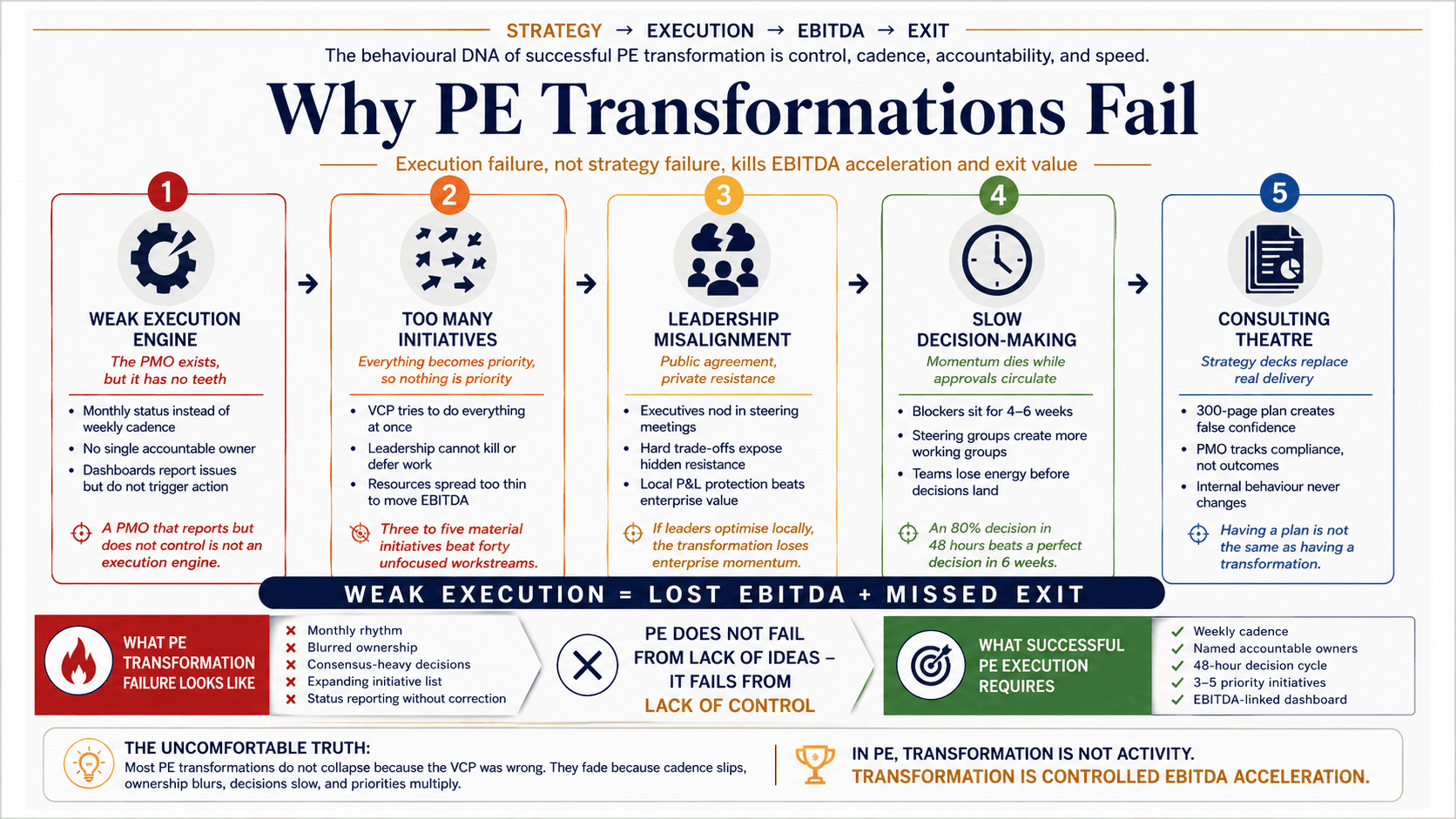
The Uncomfortable Truth About Execution, Not Strategy
Private Equity doesn’t fail because of bad strategy.
It fails when execution never becomes controlled, measurable, and real.
Everyone celebrates PE transformation stories. You hear them at conferences, in case studies, on LinkedIn. The ones where a struggling business gets acquired, undergoes a dramatic transformation, and emerges leaner, faster, and worth 3–5x more than the entry price. McKinsey publishes studies on transformation success rates. Bain publishes frameworks for managing change at scale. Harvard Business Review runs features on how enterprises successfully navigated digital transformation.
What you don’t hear are the quiet ones. The transformations that stopped halfway through. The ones where momentum died at month 4. The initiatives that looked perfect on a 100-day plan but collapsed under the weight of operational reality. The promised EBITDA that never materialised. The exit window closed because the business hadn’t actually changed.
Based on 30 years in transformation programmes — at scale, across industries, in high-stakes environments — I’ve seen enough of these failures to know they follow a pattern. I’ve worked through post-acquisition integrations at Fortune 500 firms. I’ve run PMOs on nine-figure transformation programmes. I’ve been brought in as a turnaround officer to salvage transformations that were already failing. I’ve also been the sponsor on the PE side, looking at a struggling portfolio company and asking the hard question: why hasn’t this changed?
And here’s what nobody wants to say out loud, because it’s uncomfortable and it implicates every leader who’s been through this:
Most PE transformations fail not because the strategy was wrong. They fail because the execution engine never became real.
The Five Silent Killers
When a PE-backed transformation falters, it’s almost always one of these five things. Not all at once — but usually at least two, working together to kill momentum. What’s insidious about these failures is that they don’t manifest as dramatic breakdowns. They manifest as a slow drift. As a creeping scope. As initiatives that are technically ‘on track’ but aren’t delivering the needle-moving results they were supposed to.
1. Weak Execution Engine (The PMO That Isn’t)
Here’s the dangerous assumption that disabled people make most transformations: if you build the right plan, execution will follow.
It won’t.
The most common transformation failure I’ve seen is a PMO that looks good on the org chart but doesn’t actually drive anything. It has meetings. It has workstreams. It has a 200-page roadmap with Gantt charts and resource allocations. It has governance tiers and escalation paths. It reports weekly status to steering committees. But it doesn’t have teeth.
A weak execution engine typically exhibits these symptoms:
Monthly status updates instead of weekly cadence. Transformation momentum requires constant visibility. In a monthly steering committee, too much can go wrong between meetings. Blockers that should be cleared in 2 days sit for 3 weeks. Small misses compound into big ones. A monthly rhythm is basically an admission that you’re not managing by fact — you’re managing by hope and hoping the next month’s update is better than this month’s.
No single point of accountability. When a workstream misses a milestone, who owns it? If the answer isn’t crystal clear — one name, one person, one P&L — then it’s everyone’s responsibility, which in practice means nobody’s. I watched a transformation workstream on supply chain efficiency miss three successive milestones before anyone acknowledged it wasn’t happening. Seven people were listed as ‘sponsors’ for the initiative.
Decisions deferred to consensus. I’ve watched transformations grind to a halt because the PMO couldn’t make a $2M decision without five rounds of stakeholder consultation. There’s an appeal to consensus — it feels inclusive. It feels safe. But by the time consensus forms across five business units with competing interests, the market has moved, and the initiative is already behind.
Dashboards that don’t drive behaviour. You can have all the red/amber/green metrics you want. If they don’t lead to immediate corrective action — if a red metric doesn’t trigger an emergency decision meeting within 48 hours — then you’re just producing status reports dressed up as KPIs. The dashboard serves as a cover: ‘We tracked it closely,’ the PMO says, even though nothing actually changed in response.
PMO focused on process instead of outcomes. The most dangerous transformation of PMO is one that confuses process compliance with delivery. ‘All workstreams submitted their risk registers.’ ‘Governance tiers are in place.’ ‘Change management plan is complete.’ These are process boxes. They’re not EBITDA. A transformation PMO’s job isn’t to ensure the process is perfect — it’s to ensure the business changes.
The PE firms that succeed insist on a fundamentally different operating model for the execution engine. Weekly cadence — not monthly. Unambiguous ownership — one person’s name next to each initiative. Escalation paths that clear decisions in 48 hours, not 6 weeks. Dashboards that trigger action, not just reporting. An execution engine isn’t a support function — it’s the organism that keeps the transformation moving.
2. Too Many Initiatives, Zero Prioritisation
A classic mistake in transformation planning: the first Value Creation Plan tries to do everything, because everything represents an opportunity.
Improve margins through aggressive cost reduction across all functions. Drive growth through channel expansion, product innovation, and geographic rollout. Modernise the technology infrastructure and migrate to the cloud. Restructure talent and eliminate redundancy. Get exit-ready by creating sustainable, scalable operations. Improve customer experience and NPS. Refine the go-to-market strategy. All simultaneously.
The result: thousands of people working across dozens of workstreams, nothing delivered with real impact. Small wins scattered across initiatives, but no material EBITDA impact. Teams are exhausted by complexity and context switching. Leadership is confused about what actually matters.
I was brought in to salvage a transformation at a mid-market manufacturer that was struggling. The company had been PE-backed for 18 months. The transformation had identified over 40 initiatives across cost, revenue, technology, and organisational restructuring. Every business unit was running three to four ‘high-priority’ programmes. Nobody had time to focus on anything. And EBITDA hadn’t moved.
When I asked the leadership team which initiatives they could kill without impacting the business, there was silence. They couldn’t identify any. Which meant all 40 initiatives had equal priority, which meant none of them had priority.
This is where the difference between good strategy and good execution becomes brutally obvious. A good VCP isn’t a comprehensive plan that covers every opportunity. It’s a ruthlessly prioritised sequence in which certain initiatives are deliberately NOT pursued, deliberately deferred, or deliberately killed until other initiatives land and free up bandwidth.
The successful transformations I’ve worked on typically followed a rule: three to five material initiatives at any given time. Not ten. Not ‘everything is a priority.’ Three to five. And when someone proposes a new initiative, something else gets killed or deferred. The list doesn’t grow — it rotates.
At that manufacturer, we took 40 initiatives and condensed them to 5. We said no to 35 things. Some were deferred. Some were eliminated. But the result was immediate: the five initiatives got real resources, real focus, and real accountability. Twelve months later, EBITDA had moved 300 basis points in the right direction.
This requires discipline. It requires saying no to the CFO who wants cost reduction everywhere, to the CRO who wants revenue growth, to the CTO who wants to modernise everything. It requires leadership willing to accept that you can’t do everything at once, which is politically painful, because every function always wants more. But that’s the difference between a transformation that sticks and one that fades.
3. Leadership Misalignment at the Top
This one is subtle, which makes it deadly.
The CEO is committed to the transformation. The CFO is committed. But the CTO wants to preserve legacy systems and thinks the transformation’s tech roadmap is reckless. The COO wants to protect the current-year margin rather than invest in structural efficiency. The VPs of Sales and Operations are competing for the same resources and have different priorities. The CHRO believes the workforce reduction plan is overly aggressive and will harm the culture.
On the surface, it looks aligned. They’re all in the steering committee. They all nod when the transformation roadmap is presented. They all say ‘this is strategic’ in public. But when it comes time to make hard calls — to shut down a legacy business line that’s generating cash but will never grow, to reallocate resources from a comfortable function to a growth initiative, to make a decision that benefits the enterprise but definitively hurts a particular P&L or person — the alignment evaporates.
I watched a transformation at a mid-market services firm grind to a halt because the two co-heads of the business couldn’t agree on whether to consolidate regional offices. The transformation roadmap is said to consolidate. The financial model was clear: consolidation saved $15M annually. But the emotional and political weight around it was stronger than the economic logic. One co-head had built that regional structure. Consolidating meant admitting his structure was wrong. So it sat. Unresolved. For 18 months.
Meanwhile, every month of delay costs the company $1.25M. Every month of delay made the new owner nervous. Every month of delay compressed the exit window. What should have been a 6-month initiative consumed 18 months because two leaders at the top couldn’t align.
PE doesn’t tolerate this for long. When alignment breaks, the sponsor firm brings in a transformation leader with direct authority over execution. Not a facilitator. Not a consensus-builder. Someone whose P&L is the transformation — not the business. Someone whose compensation depends on EBITDA moving. But many organisations try to drive transformation through existing leadership, where personal and political allegiances remain divided.
True leadership alignment means something specific: you will lose something on your P&L to serve the enterprise. You will accept resource reallocation that hurts your local budget. You will make decisions that aren’t in your self-interest. And you’ll do it visibly, early, and often enough that the rest of the organisation believes it’s real and not just performative.
When alignment is real, the entire organisation sees it. When it’s fake, the entire organisation sees that too. And when they see that the executive team is misaligned, they will optimise locally rather than serve the transformation — because they know the transformation won’t survive.
4. Slow Decision-Making That Kills Momentum
Momentum is perishable. It’s the most valuable asset a transformation has.
When a transformation starts, there’s energy in the market. People are committed. They see the narrative — the company will be different. Early wins are visible and celebrated. Hope is real.
Then a blocker appears. A technology decision that affects three workstreams. A resource conflict between two initiatives. A process change that touches customer-facing operations. A spending decision above a threshold that requires board approval—something that can’t be resolved without consultation, multiple stakeholder meetings, and vetting with different functions.
If that decision sits unresolved for 4–6 weeks, momentum dies. Here’s why: people get reassigned to new priorities. Energy dissipates. The narrative weakens. And by the time the decision finally comes down, the initiative that depended on it has lost 6 weeks and the team’s focus.
The organisations that fail at transformation follow a predictable decision pattern:
Issue surfaces → Issue referred to steering committee → Steering committee decides to form a working group → Working group meets for 3 weeks and develops recommendations → Recommendations escalated back to steering committee → Steering committee approves recommendation → Approval sent to executive team for final decision → Final decision comes down (or doesn’t) → Two more weeks have passed.
You’ve just lost a minimum of a month. The team has moved on. Momentum is gone. And the initiative is already behind.
PE transformations succeed because they operate with a fundamentally different decision architecture:
Issue surfaces → Transformation leader (or delegated decision-maker) identified → Decision-maker gets input from 2–3 key stakeholders (not consensus, input) → Decision made within 48 hours → Decision communicated → Execution.
This doesn’t mean reckless decision-making or bypassing needed input. It means: get the right information, identify the right decision-maker, decide faster than you think is prudent, and move forward.
The counter-intuitive truth: the ability to recover from an 80% right decision made in 48 hours is infinitely better than a 100% right decision made in 6 weeks. The 80% decision lets momentum continue. The 100% decision kills it.
5. Consulting Theatre vs Real Execution
This is the most insidious failure mode because it’s wrapped in the language of professionalism and rigour. It’s easily confused with legitimate strategy work. But the difference is crucial.
Consulting theatre happens like this:
You engage a consulting firm to design the transformation. They spend 12 weeks interviewing stakeholders, analysing data, and building financial models. They deliver a 300-page strategy document with an executive summary. The doc covers the competitive landscape, identifies 15 value opportunities, prioritises them into a roadmap, and attaches a detailed implementation plan with risks and mitigations. You host a 2-day workshop to socialise the plan to the broader organisation. You build a PMO to ‘implement the recommendations.’ The PMO serves as a reporting function to track whether internal teams are executing against the consultant’s design. For six months, everyone is busy producing status updates that show ‘progress’ relative to the plan.
Here’s what gets confused: having a plan is NOT the same as having a transformation.
A consulting engagement is designed to produce a strategy document. It’s good at that. The document covers the landscape comprehensively. It identifies opportunities. It even prioritises them. But it’s created by people who will leave in six weeks. They’re not there in month 6 when the first major blocker hits. They’re not there in month 12, when stakeholder alignment breaks down. They’re not there in month 18, when the business has changed, and the original strategy no longer applies.
The real work — the messy, grinding, day-to-day work of actually changing how an organisation operates — has to be carried out by the internal team. And if that team doesn’t have skin in the game, if the transformation is something consultants did rather than something the organisation owns, it will falter.
I worked on a retail transformation at a major chain where the consulting firm had designed a beautiful supply chain model. Warehousing consolidation. Network optimisation. Demand-driven replenishment. It was theoretically sound and showed $40M in annual benefit. The PMO tracked whether the recommendations were being ‘implemented.’ But implementation meant, roughly, compliance — checking boxes against the consulting plan, not delivering business results.
Two years and $5M in consulting spend later, inventory turns had barely improved. The transformation had generated reports, meeting minutes, change management workshops, and governance reviews. But no real change in how the business operated. Why? Because the consulting plan didn’t account for the reality that the regional supply chain teams had been doing things a certain way for 15 years. They didn’t believe in the model. They were compliant with the process but never actually changed their behaviour.
The firms that break through this trap do something different: they bring in a transformation leader with direct P&L accountability. Not to design from the outside and then hand off. But to own delivery from the inside. This person has been in the business for 24 months. They’re not consultants. They’re a member of the executive team. Their success is measured by whether EBITDA improves and whether the organisation actually operates differently, rather than by whether the consulting plan was executed.
What These Failures Reveal
Here’s what connecting these five failures reveals: transformation doesn’t fail because the strategy was wrong. It fails because the muscle to execute never developed, or developed and then atrophied.
Most organisations are structurally designed for an operational steady state. They’re good at running the business as it exists. They’re excellent at optimising within the current model. They’re terrible at changing the model itself.
When a transformation starts, that structural weakness becomes apparent immediately:
Weekly cadence? Operations run on a monthly or quarterly review cycle. Speed is foreign.
Clear accountability? Matrix organisations are designed so everyone’s accountable to multiple people and multiple objectives. Nobody owns anything completely.
Fast decisions? Most organisations optimise for consensus and risk mitigation. Everything goes through a vetting process.
Ruthless prioritisation? Every business unit wants resources and can justify its need for them. Saying no to any of them creates political friction.
Real transformation requires the opposite. It requires a different operating model — a different cadence, a different accountability structure, a different decision speed, a different prioritisation discipline.
Private Equity transformations succeed because they explicitly reject the steady-state operating model and replace it wholesale with a transformation operating model. It’s not something layered on top of the existing business. It becomes the business, at least for the 2–3 year transformation window. The old model sits in the background — operations keep the lights on. But transformation has its own governance, its own cadence, its own P&L accountability.
And when that operating model of transformation weakens — when cadence slips, when accountability blurs, when decision speed increases to months rather than weeks — the transformation fails. Not because the strategy was wrong. But because the muscle that drives execution died.
The Hard Question
If you’re reading this and you’ve been through a transformation — PE-backed or otherwise — you know which camp you fell into.
Either the execution muscle was built early and stayed strong throughout the transformation window. Weekly cadence held. Clear ownership held. Fast decisions held. Ruthless prioritisation held. And the transformation landed. EBITDA moved. The business changed. Exit happened or is happening on schedule.
Or execution slowly weakened. Cadence drifted from weekly to biweekly to monthly. Accountability blurred as people got reassigned. Decisions slowed. Priorities multiplied. And the transformation faded into the background as everyone retreated to running the business as it existed.
The uncomfortable part of all this is that the difference between success and failure usually isn’t strategy. It’s not market conditions, bad timing, or misaligned incentives — though those matter. It’s not consultant quality or the sophistication of the VCP.
It’s whether leadership had the discipline to build and maintain an execution engine that operated on a completely different cadence than the business as it existed. Whether they could tolerate the political discomfort of prioritising ruthlessly. Whether they could make fast decisions without consensus. Whether they could hold people accountable when they missed.
That’s harder than it sounds. And it’s why most transformations fail.
The Path Forward
If you’re in the middle of a transformation and feeling like momentum is fading, ask yourself these questions:
Do we have a real weekly cadence, or has it drifted? If you’ve gone to monthly steering committees, you’ve already lost momentum.
Can I name, right now, the one person accountable for each major initiative? If you can’t, or if you have to think about it, accountability is blurred.
Are we making decisions in 48 hours or 6 weeks? If big decisions are taking 6+ weeks, your decision architecture is broken.
Do I have fewer initiatives than I had last quarter, or more? If the list keeps growing, you’ve lost discipline in prioritisation.
Is the transformation led by someone whose entire P&L depends on it landing, or is it a supporting function alongside their regular job? If it’s the latter, it will fail.
—
If you’ve been through a transformation failure, I’d like to hear your perspective. What broke first? Was it execution muscle, or was it something else? What would you do differently next time?