From Project Tracking to Enterprise Value Delivery
Executive Summary: Why This Matters Now
If you are a CIO, CTO, or transformation leader, you are facing a reality your predecessors never encountered: simultaneous, parallel execution of transformations that would have been sequential in earlier eras.
Your organisation is likely managing: AI adoption and capability building; ERP system modernisation; cloud migration across hundreds of applications; cybersecurity hardening and resilience programmes; data platform development; digital channel transformation; regulatory compliance and control frameworks; and cost optimisation initiatives. All at the same time. All are competing for the same engineering talent, budget, executive attention, and vendor resources. All are carrying real organisational risk.
The traditional PMO—built for a simpler era when organisations ran discrete, sequential projects—is not designed for this environment. It produces status reports that no one acts on. It identifies risks that stakeholders have already accepted. It tracks milestones that feel increasingly disconnected from business outcomes. It often optimises for schedule and budget adherence while transformation programmes deliver little value, achieve poor adoption, or create new operational risks that are not measured.
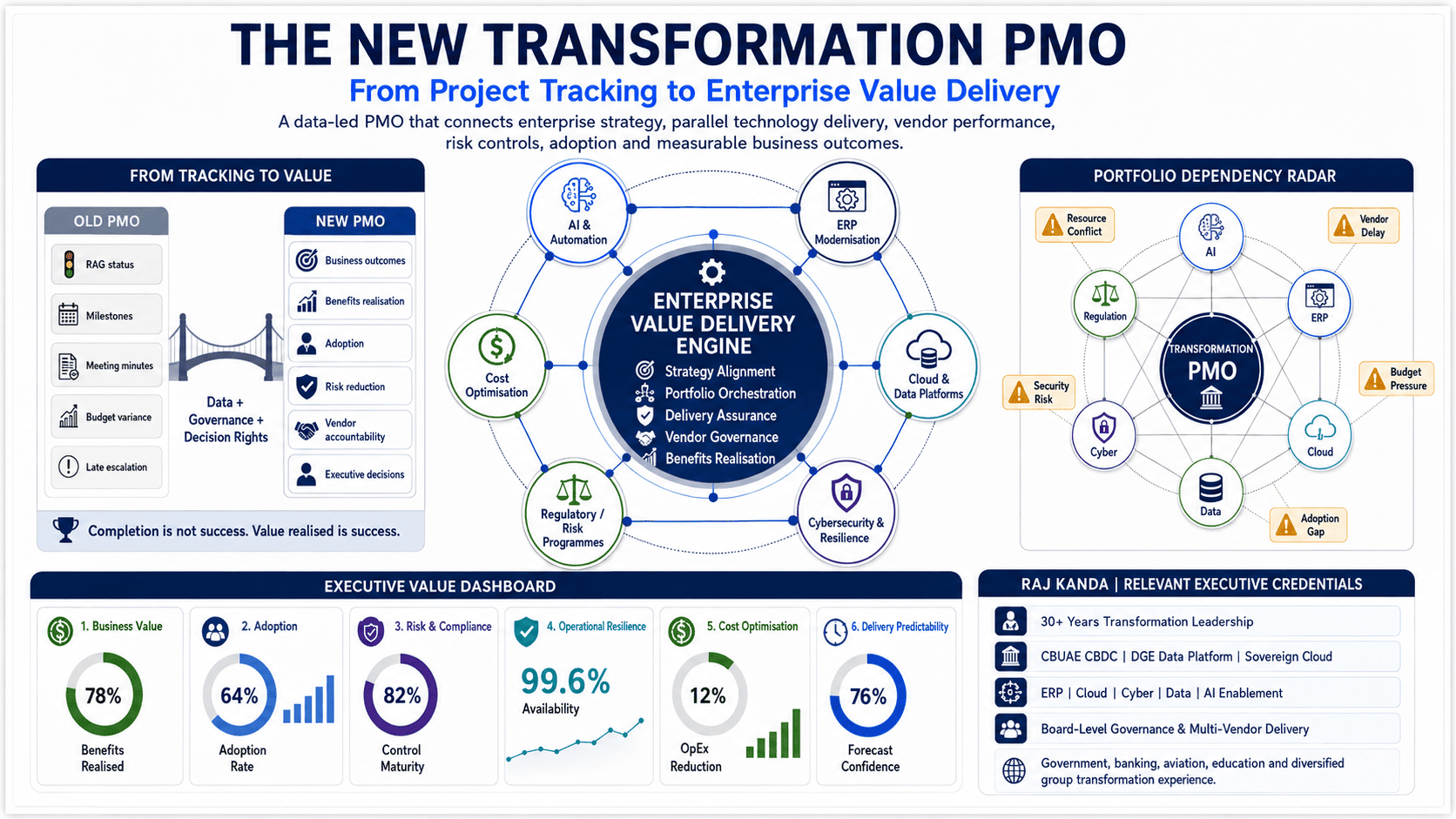
The organisations that are winning—those delivering real business value from their transformations—operate a fundamentally different model. Their PMO is not a reporting office. It is an enterprise value engine. This article explores what that means, why it matters, and how to build it.
Why Project Tracking Alone Is Not Enough
Traditional PMOs emerged in the 1990s and 2000s when enterprises ran projects sequentially. Build an ERP system. Migrate to the cloud. Deploy a data warehouse. Each project had a clear scope, defined end date, and measurable success criteria. A PMO that tracked progress, escalated risks, and controlled scope was genuinely valuable.
That world no longer exists. Modern transformation is not sequential—it is parallel and continuous. A bank cannot wait to finish one digital platform before beginning another. An enterprise cannot modernise its ERP system in isolation from its cloud strategy, data infrastructure, or cybersecurity posture. The dependencies are too complex. The pace of change is too fast. The organisational risk is too high.
When a traditional PMO focuses purely on schedule and budget tracking, it becomes a bureaucratic cost centre in this environment. It produces documents that no one acts on. It identifies risks that stakeholders have already accepted. It escalates issues at a pace that prevents timely decision-making. Worse, it often optimises for completion metrics—on-time delivery, budget variance—without asking whether the finished project is actually being adopted, creating business outcomes, or generating the benefits promised to investors.
Real value delivery requires a PMO that operates at three distinct levels: strategically (aligning transformation to business objectives), operationally (managing execution, reducing friction, coordinating delivery), and financially (tracking benefits realisation and return on investment). A PMO that does only one or two of these is incomplete and will underperform.
Connecting Strategy to Execution: The Critical Role
The most critical role of a modern PMO is to bridge the gap between enterprise strategy and programme execution. This sounds straightforward, but it is remarkably rare in practice. Most organisations have strategies and execution plans that operate in separate domains. The board approves a digital transformation strategy. Finance approves a portfolio of projects. Operations manages delivery. Three years later, the execution has little to do with the original strategy, and no one can explain why.
A value-delivery PMO changes this dynamic. It starts by translating strategy into concrete terms. What does “ become a digital-first organisation” actually mean in terms of architecture, capability, investment, and risk? What outcomes should the business expect from each major programme? What trade-offs is leadership willing to accept? What measures will we use to know we succeeded? What dependencies exist between programmes?
With strategy translated into measurable objectives, the PMO then ensures that every programme is aligned to these outcomes. This requires a sophisticated portfolio management capability: understanding not just what each programme does, but how it contributes to strategic goals, how it interacts with other programmes, what shared capabilities it depends on, and where critical sequencing exists.
It also requires the PMO to take an active—not passive—role in governance. Too many PMOs are silent observers. They report status. A value-delivery PMO actively shapes decisions. When two programmes compete for scarce engineering resources, the PMO helps leaders make the call based on strategic priority and risk exposure. When a vendor is underperforming and jeopardising other initiatives, the PMO escalates the issue and proposes solutions. When benefits are not being realised because the business is not adopting the new platform, the PMO identifies the barrier and drives corrective action.
Portfolio Complexity: The New Normal
Portfolio complexity in modern enterprises has reached unprecedented levels. Consider a typical scenario:
- AI and machine learning adoption across multiple business units
- A multiyear ERP replacement programme
- Cloud migration affecting 200+ applications
- Cybersecurity hardening responding to regulatory requirements
- Customer data platform and MarTech modernisation
- API and integration infrastructure development
- Automation and RPA programme
- Cost reduction and IT efficiency initiatives
These are not sequential. They overlap. They compete for resources. They create dependencies that can derail one another if not carefully managed. Traditional project management approaches fail at this scale. You cannot schedule 20 parallel programmes as a single waterfall plan. You cannot manage dependencies by meeting coordination alone.
You need intelligent portfolio orchestration: a single source of truth about what is planned, what is in flight, what has finished, and what is creating bottlenecks or risk. This level of visibility enables leaders to sequence initiatives in ways that maximise strategic value while managing risk, prevents the common failure mode in which programmes are approved independently with no one managing the cumulative load, and helps make hard choices about prioritisation based on strategic alignment, resource availability, and expected benefits.
Vendor and Partner Governance: A Major Source of Failure
A significant source of transformation failure is the weak governance of vendors and partners. Modern transformations depend on external partners: systems integrators, software vendors, managed service providers, niche specialists, and consulting firms. Poor vendor governance is a primary driver of cost overruns, schedule delays, quality issues, and benefit shortfalls.
Common failure modes include unclear scope definition and change control; weak accountability for partner performance; poor integration of partner delivery into overall programme governance; misaligned incentives between vendor and customer; inadequate oversight of vendor subcontractors; and failure to manage vendor dependency risk. When a critical partner is underperforming, too many organisations discover this too late—by which point corrective action becomes expensive, disruptive, or impossible.
A modern PMO takes an active role in vendor governance. This means: a clear definition of performance expectations; regular, transparent review of actual performance against these expectations; escalation protocols when performance does not meet standards; active management of change control to prevent scope creep; contingency planning for critical vendor risk. It also means ensuring that vendor delivery is integrated into overall portfolio governance—that delays or issues in vendor delivery are visible immediately, not discovered late.
Additionally, a value-delivery PMO helps reduce vendor dependency through intelligent programme design. Rather than locking an organisation into dependence on a single large systems integrator, it considers how to structure work to maintain internal capability, create competitive options, and retain strategic control. This is particularly important in large transformations spanning multiple years—vendor capabilities, cost structures, and strategic alignment change over time, and flexibility to adjust is valuable.
What the Modern PMO Should Measure
If measurement drives behaviour, then what a PMO measures defines what it optimises for. Traditional PMOs measure on-time delivery, budget variance, and schedule adherence. These are necessary but far from sufficient.
A modern PMO measures six critical dimensions:
1. Business Value and Benefits Realisation: Are the promised financial and operational benefits being delivered? What percentage of benefits are being realised within the expected timeframe? Where are benefits being lost, and why?
2. User Adoption and Effectiveness: Is the new system, platform, or process actually being used by its intended audience? What is the adoption curve? Where is adoption lagging, and what is causing it?
3. Risk and Compliance: Has the transformation introduced or left unmitigated any significant operational, financial, or compliance risk? What is the current state of control and compliance across transforming systems?
4. Operational Resilience: Has the transformation improved operational reliability and resilience, or has it created new points of failure? Is availability, performance, and disaster recovery capability adequate?
5. Cost Optimisation: Beyond the cost of the programme itself, is the solution cost-efficient to operate? Are total cost-of-ownership expectations being met?
6. Delivery Predictability: Are estimates reliable? Do programmes deliver on time and on budget? Is the organisation learning from delivery experience and improving its ability to forecast and execute?
By measuring these dimensions transparently, a modern PMO keeps the organisation focused on what matters: real business value, delivered safely, adopted successfully, and sustained reliably. This is a marked departure from the traditional focus on input metrics such as schedule and budget, which can be met even when delivering no business value whatsoever.
These metrics should be visible to the board, executive sponsors, and programme stakeholders in a single, integrated dashboard. Status should be updated at least weekly, with clear trend and variance analysis. When metrics move in the wrong direction, the PMO should escalate immediately and propose corrective actions.
Building the Modern PMO: A Practical Framework
Building a value-delivery PMO requires intentional design. It is not a minor evolution of traditional PMO practice. It is a complete reimagining of what the function does and how it operates. Here is a practical framework for the transition:
Foundation: Portfolio Governance Model
Establish a clear governance model that defines: how programmes are proposed and approved; how alignment with strategy is assessed; how trade-off decisions are made; how escalation works; and what decision rights belong to whom. This governance model should be lightweight but clear and enforceable.
Infrastructure: Portfolio Management Tools
Implement a portfolio management tool that provides a single source of truth. This should capture: Programme scope, timeline, budget, and resources; Dependencies between programmes; Risk register and mitigation plans; Benefits definition and tracking; Vendor and partner involvement; Milestone tracking and variance analysis. The tool should feed automated dashboards that are available to executives in real time.
Talent: Strategic and Operationally Capable Leaders
Recruit PMO leaders who understand not just project management but business strategy, technology architecture, finance, and organisational change. The traditional project manager skilled at scheduling is no longer sufficient. Modern PMO leaders must be strategists who understand how technology creates business value and how to navigate complex trade-offs.
Processes: Active Governance, Not Passive Reporting
Establish governance cadences that are decision-focused. Monthly portfolio steering reviews that assess alignment, resource conflicts, and dependency impacts. Quarterly strategy reviews that ask whether programmes are still aligned and whether strategic priorities have shifted. Regular vendor governance reviews that assess performance and compliance. Rapid escalation protocols for issues that require immediate executive intervention.
The Maturity Journey: Getting There From Here
Transformation of the PMO itself does not happen overnight. Here is a realistic maturity progression:
Level 1 (Current State – Traditional PMO): Focuses on schedule and budget tracking. Project-centric view. Limited visibility into benefits or business outcomes. Vendor management is ad hoc.
Level 2 (Near Term – Enhanced Visibility): Adds portfolio view. Captures dependency mapping. Introduces a benefits tracking framework. Adds vendor governance process. PMO becomes more visible to executive leadership.
Level 3 (Medium Term – Active Governance): PMO takes an active role in trade-off decisions. Portfolio is actively managed for optimisation. Benefits are tracked and realised. Vendor performance is actively managed. Strategic alignment is regularly assessed and maintained.
Level 4 (Mature State – Strategic Value Engine): PMO is fully integrated into enterprise strategy and execution. Portfolio is continuously optimised for business value. Benefits realisation is part of executive KPIs. Vendor ecosystem is strategically managed. PMO leadership is recognised as a critical executive function.
Most organisations can realistically move from Level 1 to Level 3 over 18-24 months. Level 4 is an ongoing aspiration—maturity is never complete.
The key is starting now. Pick one or two quick wins—improved dependency visibility, structured benefits tracking, or formalised vendor governance—and demonstrate value. Build credibility with leadership. Then expand progressively.
What Success Looks Like
When a modern PMO is functioning effectively, you will observe:
- Portfolio visibility. Every executive knows what is planned, what is in flight, what dependencies exist, and what the critical path looks like.
- Disciplined prioritisation. New requests are evaluated against strategy and resource availability. Not everything that could be funded is funded.
- Dependency management. Cross-programme dependencies are visible and actively managed. When one programme affects another, mitigation plans are in place.
- Benefits realisation. Programmes are not considered complete until promised benefits are delivered and sustained. The PMO tracks this obsessively.
- Vendor accountability. Partner performance is transparent and measured. When vendors underperform, corrective action is taken immediately.
- Adoption and change management. The PMO actively drives the adoption of new systems and ways of working. Adoption metrics are tracked and acted upon.
- Risk transparency. Organisational risks from transformation are visible, assessed, and mitigated. The PMO works closely with risk and compliance functions.
- Executive engagement. The PMO is seen as a strategic asset, not a reporting burden. PMO leaders are invited to participate in strategy discussions and trade-off decisions.
- Continuous improvement. The organisation learns from each transformation and improves its capabilities in estimation, planning, and execution.
Conclusion: The PMO as a Strategic Asset
The transformation of the PMO of the future is not about a project-tracking office. It is a strategic asset that helps organisations navigate complexity, align investment with strategy, manage risk, reduce delivery friction, govern vendors, and deliver sustained business value.
It requires different skills than traditional PMOs demanded: strategic thinking, business acumen, architectural understanding, financial literacy, and change leadership. It requires a different authority. A passive PMO that reports status but does not shape decisions is unlikely to succeed. The PMO must be embedded in governance, must have visibility into executive-level trade-off decisions, and must have sufficient authority to drive change and manage accountability.
For technology leaders navigating the transformation imperative—AI adoption, modernisation, cloud migration, cybersecurity, data platforms, regulatory change—the question is not whether to invest in PMO capability. The question is whether to invest thoughtfully in a PMO designed for the modern reality, or to continue with yesterday’s model and accept the risk and waste that come with it.
The evidence from high-performing enterprises is clear: the right PMO, designed as a value delivery engine, is one of the most effective investments a technology leader can make. And the time to build it is now.
━━━━━━━━━━━━━━━━━━
What does your current PMO model look like? Is it tracking projects or delivering strategic value?
I would welcome your thoughts and experiences. Share in the comments what has worked for you, what challenges you face, or what shifts you have seen in PMO practice.
#TransformationLeadership #DigitalTransformation #ProjectManagement #PMO #CIO #CTO #TechLeadership #EnterpriseTransformation #ProgrammeManagement #ValueDelivery #BenefitsRealization #VendorManagement #ChangeManagement #UAE #GCC #AITransformation #ExecutiveLeadership