Executive Summary
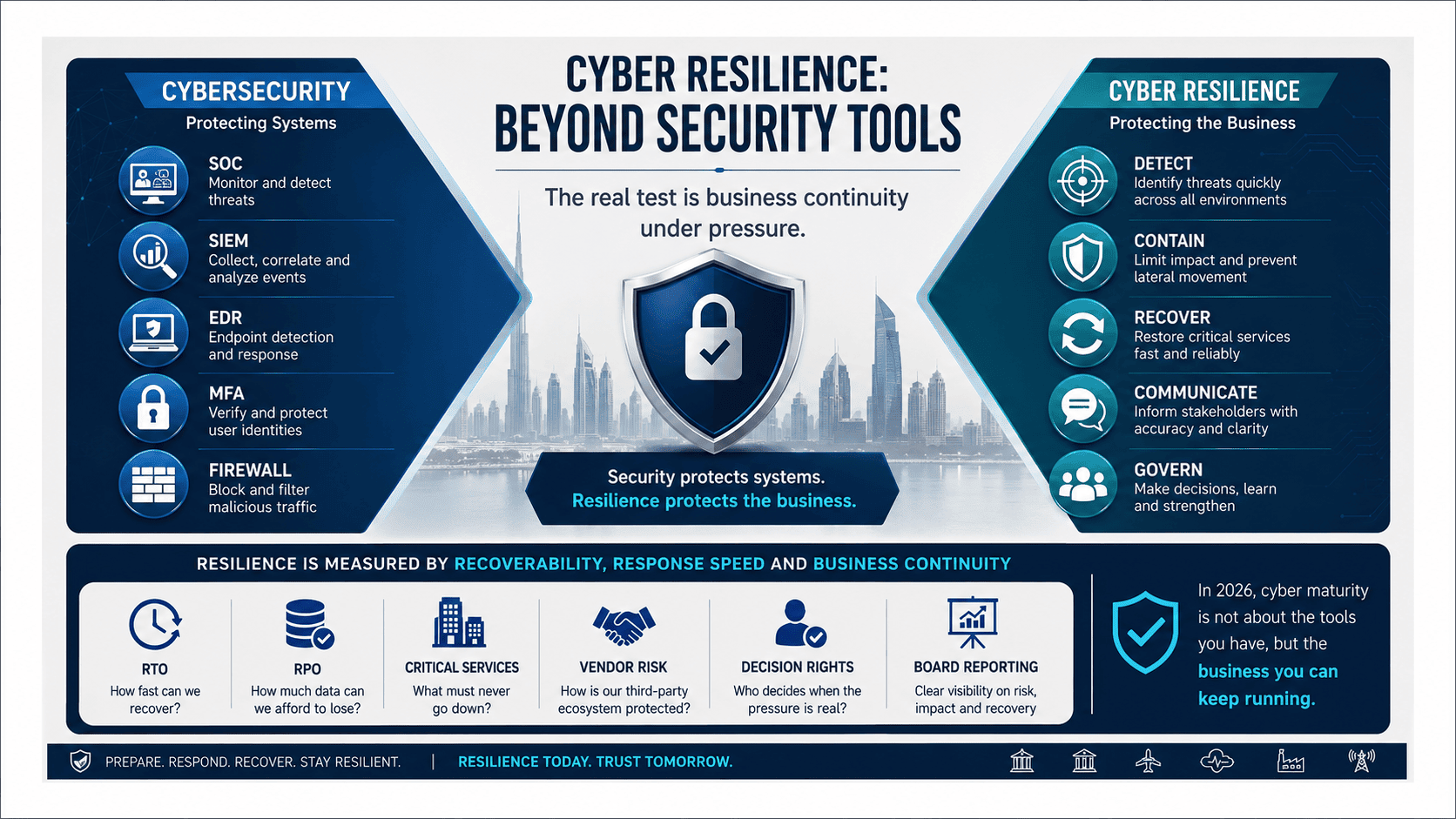
Cybersecurity and cyber resilience are not the same. Cybersecurity protects systems. Cyber resilience protects the business. As artificial intelligence, machine-speed threats, and sophisticated ransomware campaigns accelerate, organisations must fundamentally shift how they think about cyber risk—from a technical problem to a business continuity imperative.
According to the World Economic Forum’s 2026 Cybersecurity Outlook, cyber-enabled fraud, phishing, ransomware, and AI vulnerabilities have become top executive concerns. Recent strategic partnerships between the UAE and industry leaders like IBM and Palo Alto Networks underscore a critical insight: trusted AI and national cyber resilience are now inseparable from digital sovereignty and economic competitiveness.
For CIOs, CTOs, and technology leaders, this convergence creates both an urgent challenge and a strategic opportunity. Organisations that embed resilience into their operating model, governance structures, and leadership accountability will outcompete those that treat cyber as a technical compliance exercise.
Part 1: The Strategic Context
The Threat Landscape is Accelerating
The cyber threat landscape of 2026 is fundamentally different from that of even three years ago. Threats are not just more numerous—they are faster, more intelligent, and more destructive.
AI-Enabled Attacks: Threat actors are now using machine learning to identify vulnerabilities, craft targeted phishing campaigns, and exploit weaknesses at scale. A human security analyst might take days to identify a pattern of compromise. An AI-powered attack can propagate across networks in hours.
Ransomware as a Business: Ransomware is no longer opportunistic. It is now a sophisticated criminal enterprise with operational disciplines, negotiating tactics, and supply chains. Major ransomware gangs have budgets in the tens of millions of dollars and employ security researchers to discover zero-day vulnerabilities before defenders know they exist.
Supply Chain Weaponisation: Attackers increasingly target the ecosystem—vendors, contractors, managed service providers—to reach their ultimate target. A compromise of a single managed service provider can affect hundreds of downstream customers simultaneously.
Insider Risk Amplified: As remote work becomes normalised, the insider threat surface has expanded. Employees with access to critical systems are no longer confined to corporate offices, where their behaviour can be monitored. Insider threats—whether malicious or negligent—are now one of the fastest-growing sources of breaches.
Critical Infrastructure Targeting: Attacks on operational technology, industrial control systems, and critical infrastructure are increasing. These attacks often move slowly, conducting reconnaissance for weeks or months before launching a disruptive event. A successful attack on a utility, transportation system, or healthcare facility can affect millions of people.
The World Economic Forum’s 2026 Cybersecurity Outlook captures this acceleration. When surveyed, executives cite AI-enabled fraud and ransomware as their top two concerns—not because these are new threats, but because both have become dramatically more effective and difficult to defend against.
Why Speed Now Matters
In previous generations, cyber incidents unfolded over days or weeks. A breach was detected, investigated, contained, and remediated over a period that allowed for deliberate decision-making and communication.
That timeline no longer exists.
Modern ransomware can encrypt terabytes of data in hours. A compromised credential can enable lateral movement within a network in minutes. An AI-powered attack can spawn variations faster than a human security team can respond.
This speed imperative changes everything about how organisations must be structured to respond to cyber incidents.
If your incident response process requires escalation through multiple approval layers, meetings to coordinate response, and formal change management procedures, you will be unable to respond fast enough to modern threats. By the time you have assembled the decision-makers, the attack will have accomplished its objective.
Cyber resilience in 2026 requires automation, clear decision rights, pre-authorised response playbooks, and the ability to activate recovery procedures without waiting for normal business processes to take their course.
The UAE Context: Digital Sovereignty and Strategic Resilience
The UAE’s strategic emphasis on cyber resilience reflects a broader regional understanding: digital trust and cyber resilience are foundational to economic growth and digital sovereignty.
Recent partnerships between the UAE government and global cybersecurity leaders such as IBM and Palo Alto Networks are not merely procurement arrangements. They represent a strategic commitment to build capabilities, governance frameworks, and institutional knowledge that position the region as a leader in trusted AI and cyber resilience.
For enterprises operating in the UAE and broader GCC region, this creates both expectations and opportunities:
Regulatory Evolution: As governments invest in cyber resilience, regulatory frameworks will follow. Organisations that embed resilience practices early will find themselves ahead of compliance curves. Those who wait for mandates will face costly retrofitting.
Vendor Assessment Rigour: As governments establish partnerships with trusted security vendors, enterprise procurement processes will increasingly require assessments of cyber resilience maturity. Vendors that cannot demonstrate resilience capabilities will face friction in the market.
Thought Leadership Opportunity: Technology leaders who position themselves as experts in cyber resilience—not just cybersecurity—will gain a competitive advantage in executive recruitment and board-level influence. This is a moment when CIOs and CTOs can elevate from “IT operations” to “business continuity strategy.”
International Credibility: For enterprises seeking to expand beyond the region, demonstrating compliance with UAE/GCC cyber resilience standards becomes a competitive advantage. It signals maturity to international partners and customers.
Part 2: Bridging the Gap Between Cybersecurity and Cyber Resilience
The Distinction
Cybersecurity is the practice of protecting systems from unauthorised access, modification, or destruction. It focuses on prevention, detection, and response to cyber attacks. Cybersecurity asks: Can we stop the attack? Can we identify it quickly? Can we limit the damage?
Cyber Resilience is the capacity of an organisation to continue functioning during and after a cyber incident. It encompasses not just security controls, but operational redundancy, recovery capabilities, governance structures, decision-making authority, and stakeholder communication. Cyber resilience asks: Can the business continue to operate? Can we restore critical services? Can we maintain trust with customers and stakeholders?
The two are related but distinct. An organisation can have strong cybersecurity (advanced firewalls, EDR systems, threat intelligence) and still lack resilience if it hasn’t thought through how to operate when those security controls fail—and they will fail, eventually.
Why the Distinction Matters
Consider a scenario:
A large financial services firm has invested heavily in cybersecurity. It has a modern SOC with 24/7 monitoring. It has deployed EDR across all endpoints. It has segmented its networks. It has implemented MFA and zero-trust architecture. By any cybersecurity metric, it is well-defended.
An attacker compromises a third-party vendor’s API credentials and gains access to a subset of the firm’s cloud environment. The SOC detects the intrusion within 2 hours—a reasonable detection time. But the attacker has already exfiltrated customer data, including personally identifiable information, account numbers, and transaction history.
Now what?
From a cybersecurity perspective, the organisation has performed reasonably well. Detection was relatively fast. Containment followed. The attacker was removed from the environment.
But from a resilience perspective, the organisation is now in crisis. It must:
- Notify regulators (which may trigger formal investigations)
- Notify customers whose data was compromised
- Manage reputational damage
- Coordinate with law enforcement
- Conduct forensic analysis to understand the full scope of the breach
- Implement remediation to prevent recurrence
- Potentially face regulatory fines, civil litigation, and loss of customer trust
A resilient organisation would have been prepared for this scenario. It would have:
- Pre-negotiated with forensic firms and incident response providers
- Established templates for regulatory notification
- Identified which data is most sensitive and requires the fastest notification
- Designated executives responsible for decision-making during a crisis
- Established relationships with legal counsel, insurance carriers, and PR firms
- Practised crisis communication scenarios
- Established board-level oversight and reporting structures
The difference between responding to a breach with cybersecurity capability versus with cyber resilience is the difference between stopping the fire and protecting the building—and everything inside it.
The Organisational Imperative
The CISO and the security team often own cybersecurity. The entire organisation must own cyber resilience.
This requires a fundamental shift in how cyber risk is governed. Instead of cyber being a specialised domain under IT, cyber resilience must be integrated into:
- Operational Planning: Business continuity and disaster recovery procedures must account for cyber incidents, not just natural disasters or infrastructure failures.
- Risk Management: Enterprise risk management frameworks must treat cyber resilience as a strategic risk with board-level visibility.
- Finance: Budget allocation must reflect the cost of resilience—redundancy, backup systems, recovery infrastructure, and ongoing testing.
- Vendor Management: Third-party risk assessment must include cyber resilience capabilities, not just compliance certifications.
- Communications: Crisis communication teams must be trained on cyber-specific scenarios and stakeholder communication strategies.
- Legal and Compliance: Legal frameworks around incident notification, data protection, and liability must be understood and implemented.
When cyber resilience is truly embedded in organisational governance, the CISO becomes a strategic advisor to the business, not a gatekeeper managing a separate function.
Part 3: The Seven Pillars of Cyber Resilience
Effective cyber resilience rests on seven integrated pillars. Organisations must excel in all seven to claim genuine resilience.
1. Asset and Service Criticality Assessment
Before you can be resilient, you must know what you are protecting.
Most organisations have not conducted a rigorous assessment of which systems are truly mission-critical. They have compliance inventories, asset management databases, and infrastructure diagrams. But many lack clarity on: If this system fails, what business impact occurs? How long can we operate without it? What is the acceptable downtime?
Business leaders, not IT, must drive this assessment. A data warehouse might be technically complex and resource-intensive to manage, but if it is not required for real-time operations, it is not mission-critical. Conversely, a seemingly simple email system might be business-critical—many organisations cannot operate for more than a few hours without email.
Implementation Approach:
- Conduct interviews with business leaders to identify critical services
- Map dependencies between systems (Service A depends on Service B, which depends on Service C)
- Define acceptable downtime (RTO) and data loss (RPO) for each critical service
- Identify single points of failure
- Prioritise hardening, redundancy, and recovery procedures for critical services
2. Access Control and Identity Governance
Many of the most damaging cyber incidents exploit inadequate access control. An attacker gains a single user credential and, through weak access controls, escalates privileges or moves laterally through the network.
Cyber resilience requires discipline around identity and access management:
- Principle of Least Privilege: Users and systems should have access only to resources required for their role. Not “access that might be needed in the future,” but access required for current responsibilities.
- Continuous Authentication and Authorisation: Traditional identity management assumes that once a user is authenticated, they can access all resources they have been provisioned for. Modern approaches continuously validate that access is still appropriate.
- Credential Hygiene: Passwords are weak. Multi-factor authentication is necessary but insufficient if credentials are shared, reused, or poorly managed. Organisations must implement credential management solutions that rotate secrets, limit their lifetime, and audit their use.
- Privileged Access Management (PAM): Administrative credentials are high-value targets. PAM solutions record all privileged access, implement just-in-time elevation (granting access only when needed and immediately revoking it), and require dual control for sensitive operations.
3. Redundancy and Recovery Infrastructure
Resilience requires the ability to continue operating even when systems fail. This demands deliberate investment in redundancy.
Types of Redundancy:
- Geographic Redundancy: Critical systems should be replicated across multiple data centres or cloud regions such that if one becomes unavailable, another can immediately take its place.
- Technology Redundancy: Single points of failure should be eliminated. Instead of a single firewall, use redundant firewalls in active-active or active-passive configuration.
- Data Redundancy: Backup systems are not optional. Backups should be:
- Regular (daily for most systems, more frequent for high-transaction systems)
- Tested (regularly restored and validated)
- Isolated (not connected to the production network, to prevent encryption or deletion during an attack)
- Diverse (stored in multiple locations and media types)
Recovery Time Objectives (RTO):
- Tier 1 (Critical): 1-4 hours
- Tier 2 (Important): 4-24 hours
- Tier 3 (Standard): 24-72 hours
- Tier 4 (Low Priority): 72+ hours or accept permanent loss
Recovery time must be regularly tested through disaster recovery drills. A recovery plan that has never been executed is not a plan—it is fiction.
4. Operational Technology and Cloud Security
Traditional perimeter-based security (defend the edge) no longer works. Systems are distributed across cloud providers, on-premises data centres, and mobile devices. Operations technology (OT) systems that manage critical infrastructure operate on different principles from information technology (IT) systems.
Cloud Security Posture Management (CSPM):
- Continuous scanning of cloud environments to identify misconfigurations, exposed data, and non-compliance
- Automated remediation of common issues
- Visibility into who has access to what and when that access is used
- Encryption of data at rest and in transit
Operational Technology (OT) Segmentation:
- OT systems (SCADA, industrial control systems, building management) often cannot be patched or updated without disrupting operations
- OT networks must be segmented from IT networks to prevent a breach in IT from compromising OT
- OT networks require different monitoring approaches that detect anomalies without generating false positives that could cause operators to ignore alerts
5. Continuous Monitoring and Threat Detection
Detection speed directly impacts resilience. The faster you identify an incident, the faster you can contain it and limit damage.
Monitoring Requirements:
- Network Monitoring: Detect anomalous traffic patterns, unusual data flows, and communication with known command-and-control servers
- Endpoint Monitoring: Monitor for suspicious process execution, privilege escalation, and lateral movement
- Application Monitoring: Detect anomalous application behaviour, unusual database queries, and suspicious API calls
- User Behaviour Analytics (UBA): Baseline normal user behaviour and detect deviations that might indicate compromised credentials or insider threats
- Log Analysis: Centralised collection and analysis of logs from all systems to identify patterns that might indicate compromise
Alert Tuning: Security teams are overwhelmed with alerts. Most organisations generate thousands of alerts per day, the vast majority of which are false positives. Effective monitoring requires:
- Tuning alerting rules to reduce false positives
- Establishing severity levels and escalation procedures
- Automating response to low-severity, high-confidence alerts
- Focusing analyst attention on high-impact threats
6. Incident Response and Playbooks
When an incident occurs, speed matters. Incident response should not require creating a plan in the moment. Instead, organisations should have pre-defined playbooks for common scenarios.
Incident Response Playbooks Should Cover:
- Detection and Analysis: Procedures for identifying that an incident has occurred and determining its scope
- Containment: Procedures for limiting the spread of an incident (shutting down affected systems, isolating network segments, revoking credentials)
- Eradication: Procedures for removing the attacker from the environment
- Recovery: Procedures for restoring systems and services to normal operation
- Communication: Procedures for notifying stakeholders (executives, board, customers, regulators, law enforcement)
- Post-Incident Review: Procedures for understanding what happened, why current controls failed, and what must change to prevent recurrence
Pre-Authorised Response Actions: Incident response should not require waiting for approvals. Decision rights should be pre-defined:
- The CISO can shut down compromised systems without waiting for business unit approval
- IT can isolate network segments without formal change management
- Communications can issue holding statements to customers without executive sign-off
- Finance can authorise emergency spending for incident response vendors without the procurement process
7. Governance, Communication, and Board Oversight
Finally, cyber resilience must be governed at the board level, not relegated to a technical function buried within IT.
Board-Level Governance:
- The board should receive quarterly reporting on cyber resilience, not just security metrics
- Key metrics should include RTO/RPO achievement, incident response capability, and recovery testing results
- Cyber resilience should be part of the board’s risk management oversight, alongside financial risk, operational risk, and strategic risk
- The CISO or CTO should have a direct reporting line to the board or board committee, not just to the CIO
Crisis Communication: Cyber incidents are business incidents. They affect revenue, reputation, and stakeholder trust. A communication strategy must be prepared in advance:
- Identify stakeholders: customers, employees, partners, regulators, media, investors
- Develop holding statements and escalation procedures
- Pre-authorise communications to manage the narrative
- Establish cadence and content for ongoing updates
Regulatory Readiness: Cyber incidents often trigger regulatory investigations. Organizations should:
- Understand notification requirements in relevant jurisdictions
- Establish relationships with outside counsel specialising in data breach notification
- Have cyber insurance with incident response coverage
- Conduct regular training on information security and incident response procedures
Part 4: Implementation Roadmap
Phase 1: Assessment and Governance (Months 1-3)
Objectives:
- Understand current state of cyber resilience
- Establish governance structures
- Identify critical services and acceptable downtime
Key Activities:
- Conduct Risk Assessment: Evaluate current capabilities against resilience requirements. Where are the gaps?
- Establish Resilience Governance: Create a cross-functional team with representatives from technology, operations, risk, communications, and business leadership
- Business Impact Analysis: Interview business leaders to identify critical services, acceptable downtime, and recovery priorities
- Resilience Roadmap: Prioritise initiatives based on risk and business impact
Deliverables:
- Cyber Resilience Assessment Report
- Governance Charter and Decision Rights
- Critical Services Inventory with RTO/RPO definitions
- 3-Year Resilience Roadmap
Phase 2: Foundational Controls (Months 4-12)
Objectives:
- Implement identity and access management controls
- Establish backup and recovery infrastructure
- Deploy continuous monitoring
Key Activities:
- Identity and Access Governance: Implement PAM, MFA, and least-privilege access
- Backup Infrastructure: Establish isolated, geographically distributed backups with testing procedures
- Monitoring Stack: Deploy SIEM, EDR, CSPM, and UBA
- Incident Response Playbooks: Develop and test playbooks for critical scenarios
- Recovery Testing: Conduct initial disaster recovery drills for critical services
Deliverables:
- Identity and Access Management Policy
- Backup and Recovery Procedures
- Monitoring Architecture and Alerting Rules
- Incident Response Playbooks
- Disaster Recovery Test Results
Phase 3: Advanced Capabilities (Months 13-24)
Objectives:
- Automate routine incident response
- Implement advanced threat detection
- Establish vendor coordination procedures
- Build organisational muscle around resilience
Key Activities:
- Security Orchestration, Automation, and Response (SOAR): Implement automation for routine incident response tasks
- Threat Hunting: Establish the capability to search for indicators of compromise proactively
- Vendor Risk Management: Assess and monitor critical vendors for cyber resilience capability
- Tabletop Exercises: Conduct realistic crisis simulations involving business and technical leaders
- Training and Awareness: Regular training for incident responders and business leaders on resilience procedures
Deliverables:
- SOAR Automation Framework
- Threat Hunting Procedures and Findings
- Vendor Risk Assessment Framework
- Tabletop Exercise Scenarios and Results
- Training Curriculum and Completion Records
Phase 4: Continuous Improvement (Ongoing)
Objectives:
- Maintain and improve resilience posture
- Incorporate lessons learned from incidents
- Adapt to evolving threat landscape
Key Activities:
- Incident Review: After each incident, conduct a thorough post-incident review to identify process improvements
- Resilience Testing: Quarterly recovery drills for critical services
- Threat Intelligence Integration: Incorporate emerging threat information into resilience planning
- Technology Refresh: Evaluate new technologies that improve resilience
- Board Reporting: Quarterly reporting on resilience metrics and progress
Deliverables:
- Quarterly Board Reports
- Post-Incident Review Summaries
- Disaster Recovery Test Results
- Vendor Risk Assessment Updates
- Technology Refresh Evaluations
Part 5: Metrics and Measurement
How do you know if your cyber resilience program is working? Organisations must establish clear metrics that measure resilience, not just security.
Technical Metrics
Recovery Time Objective (RTO) Achievement
- For each critical service, measure: What is the target RTO? What is the actual RTO based on the last test or incident?
- Trend: Are RTOs improving over time?
Recovery Point Objective (RPO) Achievement
- For each critical service, measure: What is acceptable data loss (RPO)? How far back can we recover?
- Trend: Are RPOs meeting targets?
Backup Success Rate
- Measure: What percentage of backups complete successfully?
- Measure: What percentage of backups have been tested and verified?
- Target: 100% completion, 100% testing
Incident Detection Time
- Measure: From when an incident occurred to when it was detected, how much time elapsed?
- Trend: Is detection time improving?
Incident Containment Time
- Measure: From detection to full containment, how much time elapsed?
- Trend: Is containment time improving?
Operational Metrics
Recovery Plan Testing Frequency
- How often are disaster recovery plans tested? Target: Quarterly minimum for critical services
- How many tests were successful? Target: 100%
Incident Response Playbook Coverage
- What percentage of potential incident scenarios have documented playbooks? Target: 100% for critical scenarios
- How many playbooks have been tested? Target: 100%
Crisis Communication Readiness
- Have communication plans been prepared for various incident scenarios? Target: Yes
- Have communications teams been trained? Target: Annual minimum
Executive Decision Authority
- Is decision authority for incident response pre-defined and documented? Target: Yes
- Have incident responders and business leaders been trained on decision procedures? Target: Yes
Strategic Metrics
Third-Party Resilience Assessment
- For critical vendors, what percentage have been assessed for cyber resilience? Target: 100%
- Of those assessed, what percentage meet minimum resilience standards? Target: 100%
Regulatory Compliance
- Are all relevant regulatory requirements for incident response and notification met? Target: Yes
- How many days does it take to notify regulators of a qualifying incident? Target: Within the required notification period
Cyber Insurance Coverage
- Is cyber insurance in place? Target: Yes
- Does insurance cover incident response costs, notification costs, and business interruption? Target: Yes
Board Governance
- Does the board receive cyber resilience reporting? Target: Quarterly
- Is cyber resilience addressed in board risk oversight? Target: Yes
User Metrics
Incident Response Awareness
- What percentage of critical incident responders have been trained on procedures? Target: 100%
- What percentage of business leaders understand their role in incident response? Target: 100%
Security Awareness
- What percentage of employees have completed security awareness training? Target: 100%
- What is the phishing click rate? Target: Less than 3%
Part 6: Competitive Advantage
Organisations that prioritise cyber resilience gain a significant competitive advantage.
Speed and Agility
A resilient organisation can respond to cyber incidents faster, which means:
- Business continuity impact is minimised
- Recovery time is reduced
- Stakeholder trust is maintained
- Regulatory penalties are reduced (regulators consider speed and effectiveness of response)
This translates to real financial and operational benefits.
Customer and Partner Trust
In an era of frequent data breaches, customers and partners increasingly ask: If you are breached, can you maintain service? Can you protect my data? Can you continue our partnership?
Organisations that can credibly answer “yes” to these questions gain a competitive advantage in sales, partnerships, and market positioning.
Talent Retention
Technical talent—especially security professionals—increasingly value organisations that take security and resilience seriously. An organisation with a mature cyber resilience program can attract and retain top talent more effectively.
Board and Investor Confidence
Investors and board members increasingly scrutinise cyber risk. Organisations with mature, well-governed cyber resilience programs demonstrate lower risk and greater operational maturity. This translates to higher valuations and lower cost of capital.
Regulatory Favor
Regulators reward organisations that demonstrate proactive, effective cyber governance. When incidents occur, regulators assess how the organisation responded. A mature incident response and recovery capability can substantially reduce regulatory penalties.
Part 7: The CEO Perspective
While this article is written for CIOs and CTOs, it is important to understand what CEOs and boards are thinking about cyber resilience.
From a CEO perspective, cyber risk is not primarily a technology problem. It is a business risk. Cyber incidents can:
- Disrupt Operations: A successful ransomware attack can shut down production facilities, logistics operations, or retail stores
- Compromise Confidentiality: Data breaches can expose customer information, trade secrets, and competitive intelligence
- Undermine Reputation: Public disclosure of a cyber incident can damage brand reputation and customer trust
- Trigger Regulatory Consequences: Data breaches trigger notification requirements, regulatory investigations, and potential fines
- Create Financial Impact: Recovery costs, notification costs, litigation costs, and business interruption losses can be substantial
From the CEO’s perspective, cyber resilience is an investment that protects shareholder value. A CEO wants assurance that:
- The organisation has identified its most critical assets and services
- Those assets are protected and can be recovered if compromised
- The organisation can respond quickly and effectively if an incident occurs
- Stakeholders (customers, regulators, employees) will be managed appropriately
- The organisation will emerge from a cyber incident with its reputation and trust intact
The CIO who can frame cyber resilience in these business terms—rather than technology terms—gains significant influence and credibility with the CEO and board.
Conclusion: The Imperative and the Opportunity
Cyber resilience is no longer optional. It is a strategic imperative.
The threat landscape is accelerating. AI-enabled attacks, ransomware-as-a-service, supply chain exploitation, and targeting of critical infrastructure are all increasing in sophistication and impact. Organisations that have not prepared for cyber incidents—that have not built redundancy, governance structures, and recovery capabilities—will find themselves unable to operate effectively when incidents occur.
The cost of this unpreparedness is measured not just in technical recovery time but in business impact, regulatory penalties, reputation damage, and loss of stakeholder trust.
Conversely, organisations that invest in cyber resilience gain a significant competitive advantage. They respond faster, recover more effectively, maintain stakeholder trust, and emerge from incidents with reputation intact.
For CIOs and technology leaders, this moment represents an opportunity to elevate the conversation about cyber risk from a technical domain to a strategic business issue. The CIO who builds and governs cyber resilience effectively becomes an indispensable advisor to the CEO and board—someone who helps protect shareholder value, maintain stakeholder trust, and ensure business continuity.
The question is not whether your organisation will face a cyber incident. It will. The question is whether you will be prepared—whether your organisation has the people, processes, technology, and governance structures to respond effectively.
That is the test of cyber resilience. And in an era of machine-speed threats, it is a test that every organisation must pass.
The time to prepare is now, before the incident occurs. Before the crisis arrives. Before the window for proactive investment closes.
Cyber resilience is not a destination. It is a continuous practice of assessment, improvement, and adaptation. But the journey must begin immediately. The threats are not waiting. Neither should you.
Sources & References
World Economic Forum. Global Cybersecurity Outlook 2026. WEF, 2026. The 2026 Cybersecurity Outlook identifies AI-enabled fraud, phishing, ransomware, and AI vulnerabilities as major executive concerns and highlights the accelerating threat landscape facing enterprises globally.
UAE Government & Strategic Partners. Recent partnerships among the UAE government, IBM, and Palo Alto Networks underscore the region’s commitment to cyber resilience, trusted AI, and digital sovereignty as foundational to economic competitiveness and national security.
NIST Cybersecurity Framework (CSF) 2.0. U.S. National Institute of Standards and Technology. Provides governance and risk management baseline for organisational cyber resilience.
ISO/IEC 27001 & 27002. International Organisation for Standardisation. Standards for information security and resilience controls applicable to organisations globally.
Business Continuity Institute (BCI) Good Practice Guidelines. Provides frameworks for recovery planning, business continuity management, and disaster recovery testing.
SANS Institute. Incident Response: Processes and Procedures. Industry-standard framework for incident response playbook development and tabletop exercise execution.
About the Author
Raj Kanda is a senior technology executive with 30+ years of experience in enterprise technology transformation, digital resilience, and cyber governance across financial services, aviation, healthcare, and government sectors in the UAE, GCC, and international markets. He has led technology initiatives at CIO, CTO, and programme director levels and advises on technology strategy, governance, and operational resilience for enterprises and boards in the region.
This article is available for publication on LinkedIn, Medium, enterprise blogs, or internal strategy documents. Please cite appropriately.