Why cloud adoption is key to scalability, innovation and operational excellence
Introduction
The digital landscape has fundamentally shifted. Organisations today face unprecedented pressure to innovate rapidly, scale efficiently, and remain resilient in the face of disruption. Cloud computing has emerged not merely as a technology choice, but as a strategic imperative that shapes how enterprises compete, operate, and evolve.
For chief information officers (CIOs), chief technology officers (CTOs), and enterprise leaders, the question is no longer whether to adopt cloud technologies, but how to do so strategically. A cloud-first approach offers transformative potential—enabling organisations to respond to market changes faster, innovate at scale, and optimise operational costs. Yet this transformation is not a single-step migration; it requires a carefully orchestrated strategy that balances innovation with risk management, agility with governance, and transformation with stability.
This article examines the strategic rationale for cloud adoption, explores multiple architectural approaches (cloud-first, hybrid, and on-premises), and provides a roadmap to achieve scalability, innovation, and operational excellence while managing inherent risks and ensuring organisational resilience.
1. The Business Case for Cloud: Strategic Imperatives
Scalability and Elasticity
Cloud platforms fundamentally redefine how organisations think about infrastructure. Traditional on-premises environments require capital-intensive investments in physical hardware, with capacity planning cycles that extend months into the future. Cloud architectures eliminate this constraint. Resources scale automatically based on demand, whether responding to seasonal traffic spikes, sudden user growth, or real-time workload fluctuations.
For enterprises operating in the GCC region—where digital transformation initiatives frequently target rapid user acquisition, real-time transactions, and global service delivery—this elasticity translates to tangible competitive advantage. An organisation can launch new services, expand into new markets, or accommodate rapid scaling without the procurement delays and capital expenditure that constrain on-premises alternatives.
Innovation Acceleration
Cloud platforms democratize access to advanced technologies. Machine learning, artificial intelligence, data analytics, Internet of Things (IoT), and advanced security services—capabilities historically available only to technology leaders with substantial R&D budgets—are now accessible to organisations of any size via cloud services.
This accessibility accelerates time-to-market for new capabilities. Development teams can experiment with emerging technologies, validate business hypotheses at low cost, and rapidly scale successful initiatives. Cloud-native development patterns—microservices, containerization, serverless computing—enable organisations to build modular, independently deployable applications that evolve more rapidly than monolithic architectures. The result is an organisation that innovates continuously rather than in quarterly or annual releases.
Operational Excellence and Cost Optimisation
Cloud infrastructure eliminates capital expenditure for hardware, facilities, and associated operational overhead. Organisations shift from paying for peak capacity (which sits idle during off-peak periods) to paying for actual consumption. This consumption-based model, when combined with cloud-native architectural patterns, substantially reduces the total cost of ownership.
Beyond cost, cloud platforms provide comprehensive operational visibility. Native monitoring, logging, and analytics capabilities enable teams to understand system behaviour in detail, identify bottlenecks, and continuously optimise performance. Automated deployment pipelines, infrastructure-as-code, and policy-driven governance reduce manual operational effort and human error.
In the GCC context, where labour costs are high and specialised technical talent is relatively scarce, the operational leverage provided by cloud platforms is particularly valuable. Organisations can accomplish more with smaller operational teams, freeing resources for strategic initiatives rather than routine infrastructure management.
2. Architectural Strategy: Cloud-First, Hybrid, and On-Premises
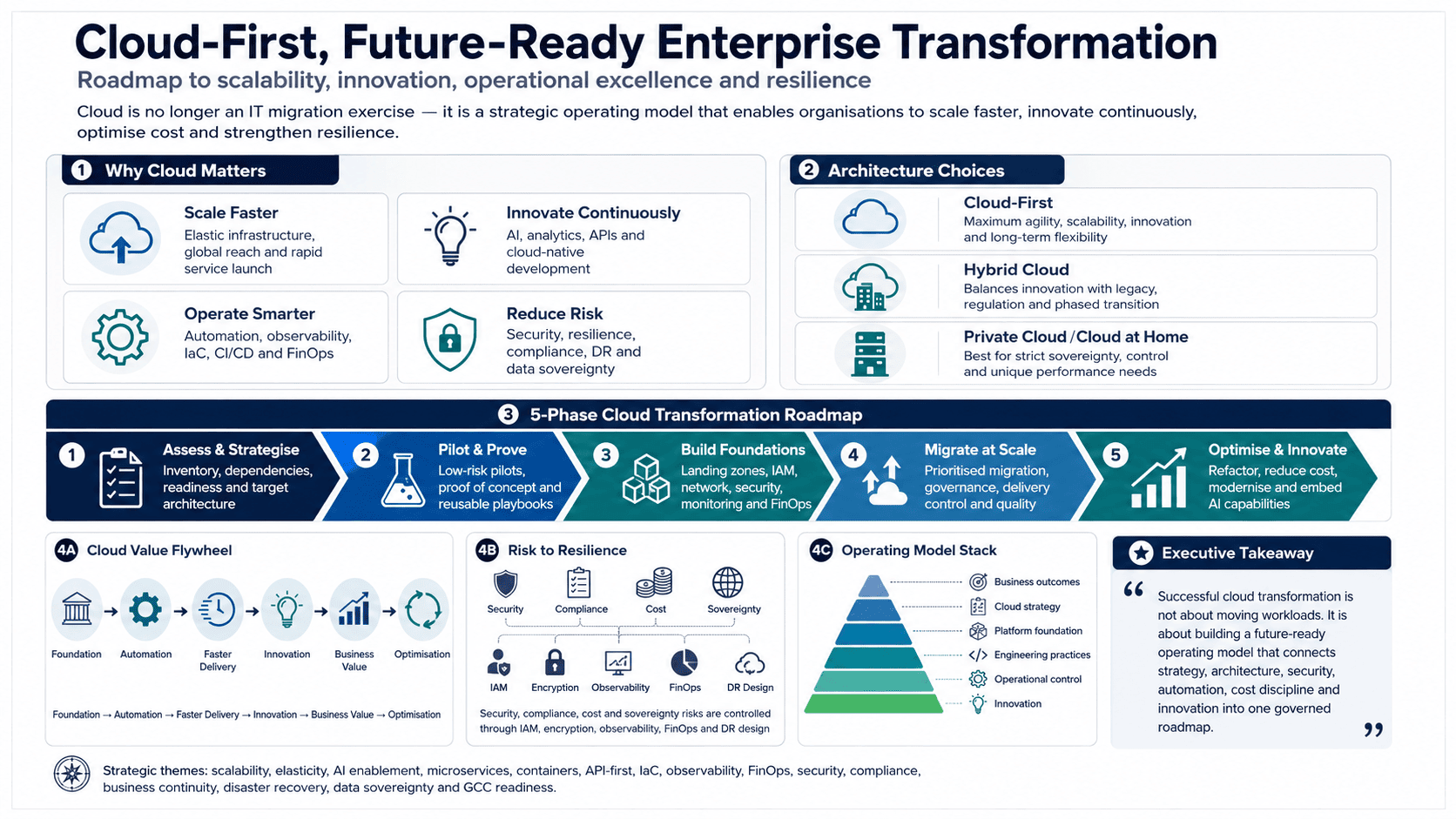
Cloud adoption is not monolithic. Organisations must choose from distinct architectural approaches, each with specific advantages, constraints, and strategic implications. These decisions fundamentally shape technology roadmaps, operational models, and organisational capabilities for years to come.
Cloud-First Architecture
A cloud-first approach makes cloud the default platform for new applications, data, and infrastructure. Legacy systems migrate to the cloud when feasible; new capabilities are born in cloud environments. This strategy maximises the benefits outlined above: scalability, innovation velocity, and operational efficiency.
Cloud-first is optimal when the organisation has the technical maturity to embrace cloud-native development practices, when regulatory constraints permit data residency in public clouds, and when the IT team has the capacity to modernise legacy systems. Technology leaders increasingly adopt this strategy because it provides the greatest long-term flexibility and competitive advantage.
Hybrid Cloud Architecture
Hybrid cloud environments span both cloud and on-premises infrastructure, with integrated operations, shared data, and coordinated workload deployment. This approach balances innovation with prudence, allowing organisations to move forward while maintaining investments in existing infrastructure.
Hybrid architectures are strategically valuable in several contexts. Regulatory requirements may mandate data residency; hybrid allows organisations to maintain sensitive data on-premises while leveraging the cloud for non-sensitive workloads. Legacy applications with complex interdependencies may be impractical to migrate immediately; a hybrid approach allows them to coexist with cloud-native applications. Performance-sensitive workloads may benefit from proximity to on-premises infrastructure while other components operate in the cloud.
However, hybrid architectures introduce operational complexity. Managing consistent security policies, data governance, and monitoring across disparate environments requires sophisticated tooling and organisational discipline. The long-term strategic trajectory should be toward either a committed cloud-first or a committed on-premises approach; sustained hybrid approaches often represent transitional states rather than stable end-states.
On-Premises (Cloud at Home)
Some organisations deploy cloud infrastructure technologies within their own data centres, leveraging containerization, Kubernetes, and cloud-native operational patterns without moving data beyond their physical control. This approach—sometimes called “cloud at home” or private cloud—offers cloud-like operational benefits while maintaining complete data sovereignty and control.
This strategy appeals to organisations with stringent data sovereignty requirements, those operating in heavily regulated industries, or those with unique performance requirements. However, it requires significant investment in infrastructure expertise and does not provide the elasticity or cost advantages of public cloud. Organisations pursuing this path must have the technical depth to manage cloud infrastructure independently.
3. Enabling Scalability Through Cloud Architecture
Scalability requires more than simply deploying to cloud infrastructure; it demands architectural decisions that enable systems to grow without proportional increases in complexity, cost, or operational overhead.
Microservices and Modular Design
Cloud-native architectures decompose applications into small, independently deployable services. Each service owns a specific business capability, maintains its own data, and communicates with other services through well-defined interfaces. This modularity enables teams to scale individual services independently based on specific demand patterns.
Rather than scaling an entire monolithic application when authentication services experience peak load, teams scale only the authentication service. This targeted scaling reduces wasted capacity and optimises resource utilisation. Equally important, small services are faster to modify, deploy, and validate—accelerating innovation velocity.
Containerization and Orchestration
Containers package applications with their dependencies, ensuring consistency between development and production environments. Orchestration platforms like Kubernetes automate the deployment, scaling, and management of containerised applications across multiple nodes.
This combination provides elasticity at scale. When demand increases, orchestration platforms automatically provision additional container instances. When demand decreases, they deallocate unnecessary resources. This automation enables organisations to achieve near-optimal resource utilisation without manual intervention.
Data Architecture for Scale
As organisations scale, data volumes grow exponentially. Traditional centralised databases become bottlenecks. Cloud-scale architectures distribute data across multiple systems based on access patterns. Some data lives in fast, low-latency caches for frequently accessed information. Other data resides in searchable indices for analytical queries. Large datasets are stored in object storage optimised for batch processing.
This polyglot persistence approach—using different database technologies for different use cases rather than forcing all data into a single system—enables organisations to scale data platforms to petabyte scales while maintaining acceptable performance and cost.
4. Driving Innovation Through Cloud Enablement
Innovation is not simply about adopting emerging technology; it encompasses the organisational capability to experiment, learn, and iterate rapidly. Cloud platforms accelerate this cycle.
AI and Machine Learning as Accelerators
Cloud providers offer pre-built machine learning models, managed training services, and inference platforms that enable organisations to embed AI capabilities without having to build from scratch. Teams can experiment with AI applications—predictive analytics, computer vision, natural language processing—at low cost and low risk.
In the GCC market, organisations are increasingly using machine learning to optimise business operations: financial services firms leverage AI for fraud detection and risk assessment; retail companies use computer vision for inventory management; government entities apply predictive analytics to resource allocation. Cloud platforms make these capabilities accessible.
API-First Development and Integration
Cloud-native organisations embrace API-first development, where applications communicate through well-documented, versioned interfaces. This approach enables ecosystem development—internal teams, partners, and third-party developers build on top of published APIs, creating a multiplier effect for innovation.
API ecosystems reduce time-to-market for new services, enable faster integration with partners, and create network effects as the ecosystem grows. Many successful digital transformation initiatives in the GCC region have been enabled by organising around APIs rather than monolithic applications.
Continuous Integration and Deployment
Cloud platforms enable continuous integration and deployment (CI/CD) pipelines that automate testing, validation, and release processes. Rather than deploying new capabilities quarterly or annually, organisations deploy multiple times daily. Each deployment is smaller, lower-risk, and easier to validate.
This shift from batch releases to continuous delivery fundamentally accelerates innovation. Organisations learn from real users faster, iterate on feedback more quickly, and maintain a competitive advantage by responding to market changes within days rather than months.
5. Achieving Operational Excellence
Operational excellence encompasses automation, visibility, cost management, and resilience. Cloud platforms provide native tooling for each.
Infrastructure as Code and Automation
Infrastructure as Code (IaC) treats infrastructure configuration as versioned, tested software. Rather than manually provisioning servers and networks, teams define infrastructure in code, commit it to version control, and deploy it through automated pipelines. This approach reduces human error, enables rapid provisioning, and makes infrastructure reproducible.
Automation extends beyond infrastructure provisioning to operational tasks: applying security patches, backing up data, rotating credentials, and executing recovery procedures. Automated operations reduce manual toil and enable teams to focus on strategic improvements.
Comprehensive Observability
Operational excellence requires deep insight into system behaviour. Cloud platforms provide native monitoring, logging, tracing, and metrics collection across the entire infrastructure. Organisations gain complete visibility into application performance, resource utilisation, user behaviour, and system health.
This observability enables organisations to identify performance bottlenecks, detect anomalies early, troubleshoot issues faster, and understand the root causes of failures. Advanced alerting and automation respond to detected issues before they affect users.
Cost Optimisation and FinOps
Cloud’s consumption-based pricing model creates new opportunities for cost optimisation but also new risks of unexpected bills. Financial Operations (FinOps) is an emerging discipline that brings financial accountability to cloud spending through cross-functional collaboration between engineering, operations, and finance teams.
Effective FinOps practices include establishing chargeback models that make cloud costs visible to business units; optimising instance sizing and purchasing reservations; eliminating idle resources; and continuously monitoring spending patterns. Organisations that mature their FinOps practice typically reduce cloud spending 20-40% while maintaining or improving capabilities.
6. Risk Management and Organisational Resilience
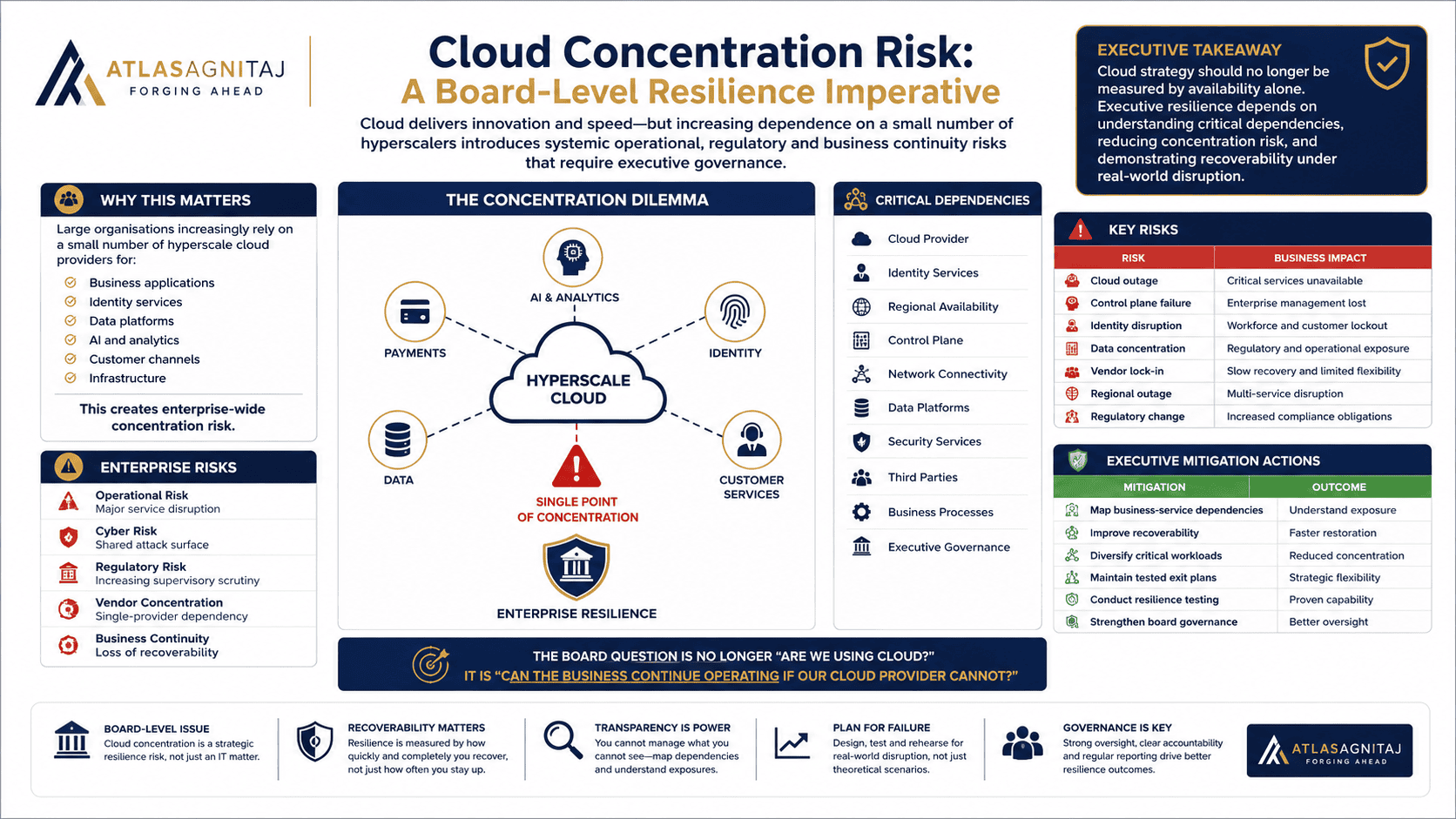
Cloud adoption introduces new security and operational risks that must be actively managed. Organisations pursuing cloud transformation must establish comprehensive risk management and resilience frameworks.
Security and Compliance
Cloud platforms provide extensive security capabilities, but security is a shared responsibility. Cloud providers secure the infrastructure; customers secure their applications, data, and access controls. Organisations must establish comprehensive cloud security programs, including identity and access management, data encryption, network segmentation, vulnerability management, and continuous compliance monitoring.
In regulated industries (financial services, healthcare, government), compliance with sector-specific regulations is essential. Organisations must understand regulatory requirements for data residency, data sovereignty, audit trails, and incident response, and then design cloud architectures that meet these requirements.
Business Continuity and Disaster Recovery
Cloud platforms enable more robust disaster recovery than traditional on-premises environments. Organisations can replicate data across multiple geographic regions, automatically fail over to secondary environments when failures occur, and recover in minutes rather than hours.
However, achieving high availability and disaster recovery requires deliberate architectural design. Organisations must define recovery time objectives (RTO) and recovery point objectives (RPO), design architectures that meet these targets, test failover procedures regularly, and maintain runbooks for incident response. Many cloud disasters result from inadequate disaster recovery design, not from cloud platform failures.
Vendor Lock-in and Portability
Organisations sometimes resist cloud adoption due to concerns about vendor lock-in—the fear that moving to a specific cloud provider will become prohibitively expensive or impossible. While this concern deserves consideration, mature cloud strategies balance this risk through multiple approaches.
Organisations can design multi-cloud architectures that distribute workloads across multiple providers, reducing dependence on any single vendor. They can prioritise portable technologies (Kubernetes, open-source software) over proprietary offerings. They can maintain exit strategies and cost models that account for switching costs. Rather than avoiding the cloud due to lock-in concerns, organisations manage lock-in risks through deliberate architectural choices.
In the GCC context, where organisations face growing geopolitical considerations around data residency and platform independence, multi-cloud strategies and open-source technologies often offer valuable strategic optionality.
7. Implementation Roadmap: Transitioning to Cloud
Cloud transformation is a multi-year journey requiring careful planning, phased execution, and continuous adjustment based on organisational learning.
Phase 1: Assessment and Strategy
Begin by comprehensively assessing the current state: inventory applications and infrastructure; understand dependencies and data flows; identify regulatory constraints and security requirements; evaluate team capabilities and skill gaps. Define the target architecture: will the organisation pursue a cloud-first, hybrid, or on-premises approach? What are the priority business outcomes? What is the financial case?
Assessment requires an honest evaluation of organisational readiness. Do teams have cloud experience, or will significant reskilling be required? Is leadership committed to the multi-year transformation journey? Are there regulatory or technical constraints that shape architecture options? Assessment clarity enables realistic planning and informed decision-making.
Phase 2: Pilot and Proof of Concept
Rather than attempting a large-scale migration immediately, establish a pilot program. Select low-risk applications that represent the intended target architectures, migrate them to the cloud, and validate the approaches. Pilots achieve several objectives: they validate architectural assumptions, build team experience, identify gaps in tooling and processes, and generate concrete business results that strengthen stakeholder confidence.
Effective pilots produce reusable artefacts: migration playbooks, deployment automation, security policies, and operational runbooks. These assets then accelerate subsequent migrations.
Phase 3: Foundation Building
Before scaling migrations broadly, establish foundational capabilities: cloud governance frameworks, security policies, network architecture, cost management systems, and operational procedures. Foundational investments prevent costly rework later.
Foundation building includes: establishing landing zones (preconfigured environments where workloads operate safely); implementing centralised logging and monitoring; defining identity and access management policies; establishing data governance and backup procedures; and implementing cloud financial management and chargeback systems. These investments enable teams to migrate with confidence that workloads will operate securely, reliably, and cost-effectively.
Phase 4: Scaled Migration
With foundations established, scale migrations across the application portfolio. Prioritise migrations based on: business impact (higher-impact applications first), technical readiness (simpler migrations before complex ones), and portfolio balance (maintain operational stability while transforming).
Scaled migration requires continuous capacity management: ensuring teams have sufficient bandwidth, maintaining velocity without sacrificing quality, and preventing transformation fatigue. Most organisations discover they underestimate migration complexity and should plan for longer timelines than initial estimates suggest.
Phase 5: Optimisation and Innovation
After applications reach the cloud, the optimisation phase begins. Review cost structures and optimise cloud spending; refactor applications to leverage cloud-native capabilities fully; consolidate tooling and processes; upskill teams to mature cloud practices. Organisations that treat cloud adoption as a migration project rather than a continuous transformation often fail to capture the full benefits of the cloud.
Mature organisations transition from reactive optimisation to proactive innovation: continuously evaluating emerging cloud services, experimenting with new technologies, and evolving architecture to support evolving business needs.
8. GCC Market Context and Considerations
Cloud adoption in the GCC region is shaped by unique contextual factors that influence technology strategies and implementation approaches.
Data Sovereignty and Localisation
Increasingly, GCC governments and regulators mandate that critical data remain within national borders or be hosted on locally registered entities. Some sectors prohibit public cloud altogether. These requirements necessitate careful architecture choices: private cloud deployments, data residency guarantees from public cloud providers, or multi-cloud approaches that maintain sensitive data locally while leveraging cloud for non-sensitive workloads.
Organisations must engage regulatory and legal teams early in the cloud strategy process to understand data localisation requirements and design compliant architectures.
Talent and Capability Development
The GCC region has a strong demand for cloud expertise but a limited local supply of experienced cloud engineers, architects, and operators. Organisations must invest in talent development: training existing teams, recruiting international expertise, and retaining skilled professionals. Consider partnering with training providers, establishing centres of excellence, offering competitive compensation, and providing clear career progression for cloud specialists.
Organisations that successfully build cloud capability often combine internal development, selective external hiring, and strategic partnerships to bridge skill gaps while building sustainable internal capacity.
Regional Cloud Services
Global cloud providers are increasingly establishing regional data centres and services in the GCC. Organisations should evaluate regional offerings—which may provide better latency, data residency compliance, and local support—alongside global alternatives. Some organisations benefit from multi-cloud strategies that combine global and regional providers.
Conclusion: The Strategic Imperative
Cloud adoption is no longer a tactical IT initiative; it is a strategic business imperative. Organisations that successfully navigate cloud transformation gain substantial competitive advantages: they scale faster, innovate more rapidly, and operate more efficiently than competitors locked into legacy infrastructure.
However, cloud transformation requires more than technology adoption. It demands strategic thinking about business objectives, organisational readiness, and risk management. It requires leadership commitment to multi-year transformation journeys. It requires continuous learning and evolution as cloud technologies mature and organisational capabilities develop.
Organisations that approach cloud as a strategic initiative—carefully assessing their context, choosing appropriate architectural approaches, investing in foundational capabilities, and executing phased implementation roadmaps—position themselves for sustained innovation and competitive advantage in an increasingly digital world.
The roadmap outlined in this article provides a framework for this journey. Cloud-first, future-ready organisations begin with a clear strategy, invest in capabilities and talent, establish governance and risk management frameworks, execute phased transformations, and continuously optimise and innovate. The investment is substantial, but the competitive returns justify the effort.